
In short
Online personal training software can either give trainers tools to configure or provide a service they can start selling. Pocket Trainer follows the second route: it supplies a client app, workout content, customizable plans, a sales page, and optional payment handling, but it is not designed for trainers who want a trainer-owned app or self-produced workout-video library. (pocket-trainer.co)
Key takeaways
- Online personal training software should support the whole client journey: delivery, communication, selling, and payment collection, not only workout programming.
- Pocket Trainer supplies a client-facing app, a workout library, customizable workout and nutrition guidance, a customizable sales page, and automated prospect follow-up. (pocket-trainer.co)
- Trainers can collect payments themselves and keep 100% of that revenue, or use Pocket Trainer's recurring-payment checkout, where the published split is 90% to the trainer and 10% to Pocket Trainer. (pocket-trainer.co)
- Pocket Trainer is a better fit for trainers who do not want to build an app, produce a video library, or assemble a sales funnel from scratch. (pocket-trainer.co)
- ✅ A platform can reduce setup work, but it cannot decide your audience, price, coaching boundaries, or client experience for you.
Table of contents
- What should online personal training software actually help you launch?
- Do you need software tools or a ready-made online offer?
- What does Pocket Trainer include, and what stays with you?
- How does payment handling work?
- Which trainers are a match, and who should choose another route?
- Frequently asked questions about online personal training software
- What should you do before choosing software?
What should online personal training software actually help you launch?
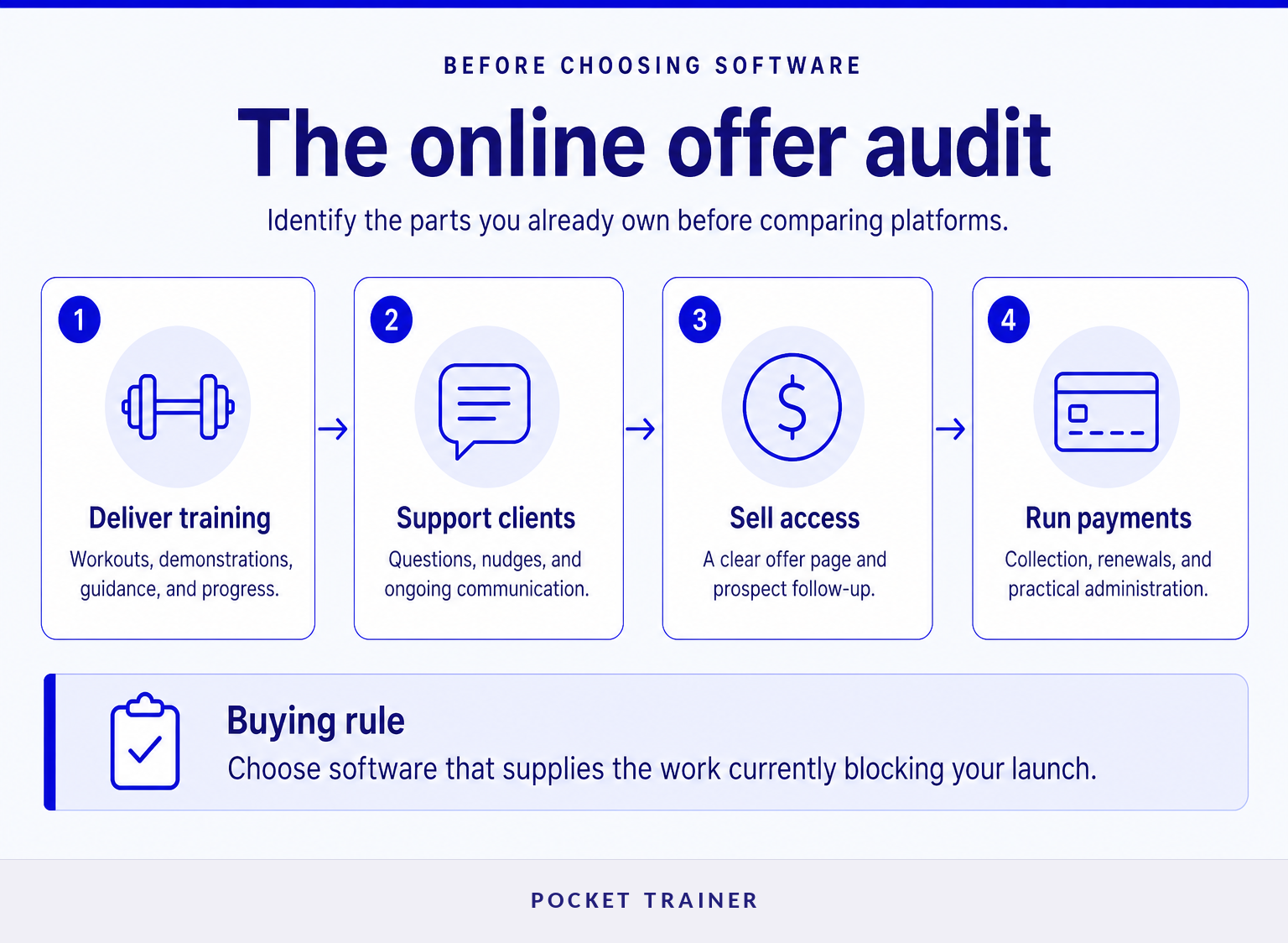
Online personal training software should help you deliver a consistent client experience, not simply place workouts inside an app. Before choosing a platform, decide whether you need help with delivery alone or need a complete offer that clients can discover, buy, and use.
A useful online offer has four connected jobs:
- Client delivery: workouts, exercise demonstrations, nutrition guidance, goals, and progress monitoring.
- Client support: a practical way to answer questions and keep clients moving between sessions.
- Selling: a page that explains the offer and gives prospects a clear route to join.
- Operations: a way to collect payment and see what still needs attention.
Many online fitness trainer software products are strongest at the first job. That can be exactly right when a trainer already has a library, a website, a payment process, and a clear way to win leads. It is a different proposition for a trainer who has in-person clients, limited admin time, and no digital product ready to sell.
Pocket Trainer positions its platform around the wider launch problem. Its published platform details describe a customizable trainer sales page, supplied workout and nutrition content, in-app client communication, plan customization, progress monitoring, and automated email follow-up for people who visit a sales page. (pocket-trainer.co)
The important question is not, "Does this platform have enough features?" It is, "Which parts of my online service are already ready, and which parts must I create and run myself?"
The best software choice is the one that removes the work currently stopping you from putting a clear online offer in front of clients.
Do you need software tools or a ready-made online offer?

A configurable platform gives trainers more control over the components of their business. A ready-made offer gives trainers fewer things to build before they can begin selling, but it also sets clearer limits on what can be customized.
Think of the choice as two routes.
A tools-led route is for trainers who want to shape every layer of the experience. You may want to record your own exercise demonstrations, build a custom content library, control the app identity, connect specialist systems, and design your own lead process. That route can be worthwhile, but it asks you to own more decisions and more setup work.
A done-for-you route is for trainers who want to package an online service without first becoming a videographer, app builder, web designer, or funnel operator. Pocket Trainer provides the client app and workout library, then lets trainers customize client workout and nutrition plans while using a trainer-specific sales page to promote the service. (pocket-trainer.co)
The trade-off needs to be explicit. Pocket Trainer's own published guidance says it is not for trainers who want to record their own workout videos or create their own app and sales page. It also does not present itself as a live-video scheduling system, a wearable-integration hub, or a full trainer-controlled CRM. (pocket-trainer.co)
That is not a weakness for every trainer. A standardized offer can be a sensible starting point when speed, low setup effort, and a consistent client experience matter more than complete technical control.
Choose the model that matches the work you are willing to keep, not the longest feature list.
What does Pocket Trainer include, and what stays with you?
Pocket Trainer supplies several parts of an online personal training service that trainers otherwise need to source or create. The trainer still owns the business decisions that make the service credible: who it is for, what it costs, how it is positioned, and how coaching quality is maintained. (pocket-trainer.co)
| What an online offer needs | What Pocket Trainer supplies | What stays with the trainer |
|---|---|---|
| Client workout experience | A client-facing fitness app and a supplied workout-video library | Choosing who the service is for and adapting plans to each client |
| Workout and nutrition guidance | Customizable workout plans and nutrition guidance | Applying professional judgment and setting appropriate client expectations |
| A way to sell access | A customizable sales page with a custom URL, trainer details, and optional media | Sharing the page, explaining the offer, and earning client trust |
| Prospect follow-up | A published automated email sequence for sales-page visitors | Deciding the offer, message, price, and broader marketing activity |
| Ongoing client communication | In-app communication, plus optional virtual-assistant support for client questions and nudges | Setting the coaching standard and reviewing client needs |
| Payment collection | A direct-payment option or optional recurring card checkout | Selecting the price and deciding which collection route suits the business |
Pocket Trainer's platform page says its virtual assistants can handle client questions, follow-ups, and motivational nudges when a trainer is busy. That can help a growing roster, but trainers should decide in advance which conversations require their own involvement and which routine messages can be delegated. (pocket-trainer.co)
The sales-page component matters because an app alone does not explain why someone should pay for access. Pocket Trainer states that it can set up a customizable page that uses a trainer's custom URL, headline, headshot, and optional welcome video or client imagery. (pocket-trainer.co)
This model is most useful when the trainer wants a sellable service now, rather than a blank system that still needs content, web pages, and a client acquisition path.
A supplied platform can shorten the path to launch, but the trainer remains responsible for the promise, price, and level of coaching behind the offer.
How does payment handling work?
Payment handling changes the economics of an online offer, so it should be understood before a trainer sets a price. Pocket Trainer says trainers can collect payments directly and keep 100% of the payment, or use its recurring card checkout, where the published split is 90% to the trainer and 10% to Pocket Trainer. (pocket-trainer.co)
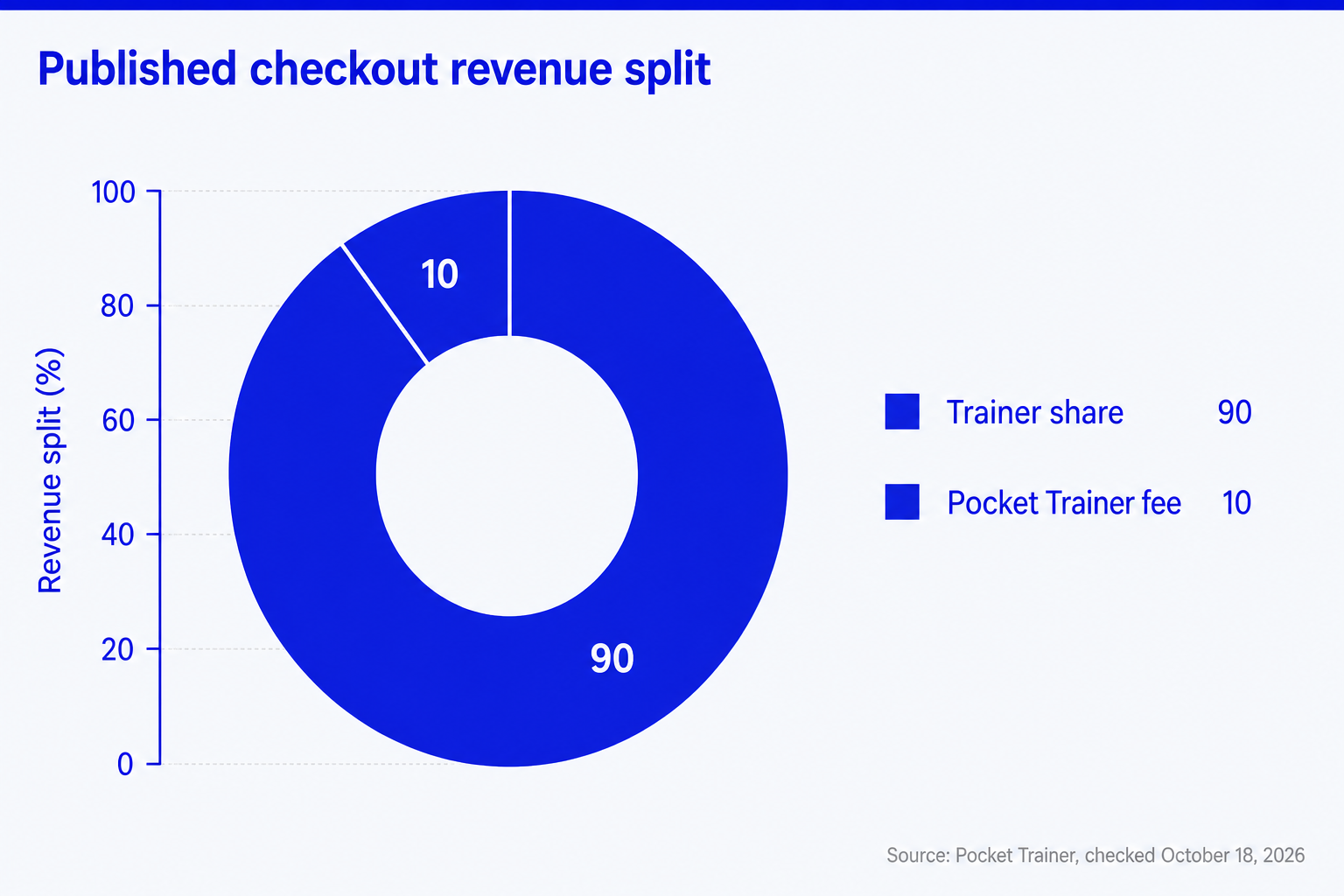
The direct-payment route may suit trainers who already have a reliable way to collect money and manage renewals. The managed-checkout route may suit trainers who want recurring billing handled within the platform's offer. Neither number tells you your profit, because taxes, advertising, refunds, and the value of your time are separate business costs.
Use the payment option that makes your pricing understandable to clients and manageable for your current operations.
Which trainers are a match, and who should choose another route?
Pocket Trainer is most relevant to trainers who want to add remote or hybrid revenue without producing a workout library and building a digital sales system first. It is less suitable for trainers whose offer depends on full white-label control, original on-demand video production, advanced integrations, or formal lead-pipeline management. (pocket-trainer.co)
Pocket Trainer may fit if these statements sound familiar:
- You have face-to-face clients who need training support when they travel, move, or cannot attend every session.
- You want an online service but do not want to spend months filming exercise content.
- You need a client app, an offer page, and prospect follow-up before you can confidently market online access.
- You want to adjust client workout and nutrition guidance while using supplied exercise content. (pocket-trainer.co)
- You may benefit from in-app communication support as client volume grows. (pocket-trainer.co)
Another route is likely better if your business needs a trainer-owned app, a library of your own uploaded exercise videos, live appointment scheduling, wearable-data connections, detailed intake workflows, or a customizable CRM. Those are not small preferences. They shape the kind of business system you need.
If your priority is launching a practical online offer with fewer moving parts, see how Pocket Trainer is set up and compare its supplied components with the assets you already have.
A good fit is about the operating model: choose a supplied platform when reducing build work matters more than owning every technical component.
Frequently asked questions about online personal training software
What is the best online fitness training app?
The best online fitness training app is the one that matches the service you are actually selling. Trainers who want to build every asset may prefer configurable software; trainers who need a client app, supplied workout content, and a sales page should prioritize a done-for-you launch model.
How much is a 1 hour PT session?
An hour of personal training has no single global price because rates vary by market, trainer experience, session format, and whether the service includes ongoing coaching. Separate the client price from software decisions: calculate what delivery, payment handling, and support cost before setting an online offer.
How much money do online personal trainers make?
Online personal trainers do not earn a standard amount. Revenue depends on client pricing, retention, service scope, operating costs, and how much delivery can happen without adding one-to-one hours. A software platform can reduce setup work, but it does not guarantee client demand or income.
The right platform supports a viable offer, but business results still depend on positioning, client trust, retention, and delivery quality.
What should you do before choosing software?
Start with one clear offer, then check whether the software supports it without forcing you into work you do not want to do. Write down your target client, monthly or program price, what clients receive, how questions will be handled, and what needs to happen after someone decides to join.
Then make two lists. In the first, put the components you already own: content, website, payment collection, follow-up process, and support capacity. In the second, put the components you would rather have supplied. The gap between those lists is the real requirement for online software for personal trainers.
The platform should fit the business you can run consistently next month, not an idealized version you may build years from now.