
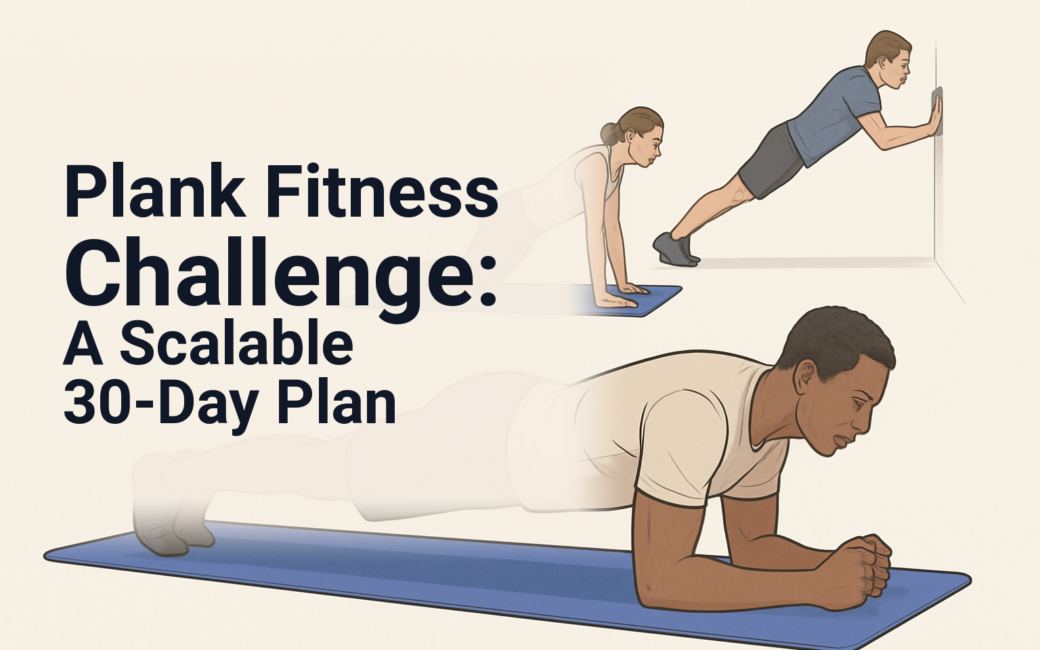
In short
A plank fitness challenge should build control and endurance, not force everyone toward the same hold time. Choose a wall, knee, or full plank you can perform with steady breathing, train it three nonconsecutive days per week, progress only while form stays clean, and treat pain as a reason to stop or modify.
Key takeaways
- The American College of Sports Medicine's 2011 position stand recommends resistance exercise on two to three days each week and says programs should reflect the participant's health, function, exercise response, and goals.
- A plank set ends when alignment or normal breathing fails, even if the timer has not reached the planned duration.
- A 2011 randomized abdominal-exercise trial improved muscular endurance but did not reduce body weight, body-fat percentage, abdominal circumference, or abdominal subcutaneous fat over six weeks.
- The exact calendar below is a conservative training template, not a clinically validated 30-day protocol or a substitute for individualized coaching.
- Pain, feeling unwell, chest discomfort, lightheadedness, or unusual shortness of breath are reasons to stop rather than finish the timer.
Table of contents
- What makes this plank fitness challenge different?
- How do you set a safe starting level?
- What is the 30-day plank fitness challenge schedule?
- How should a plank feel and look?
- What results can you realistically expect?
- When should you stop or modify the challenge?
- How can trainers adapt the challenge for clients?
- What else do people ask about plank challenges?
- What should you do after day 30?
The “had to try it” impulse and the rule of “adding one second to the day before's set” make plank challenges easy to understand. Neither phrase explains what to do when the starting position is too hard, form fails, or the wrists, shoulders, or back hurt.
This plan treats duration as one training variable rather than the whole goal. It is intended for generally healthy adults and can be adapted by trainers, but it cannot account for an individual's medical history, injuries, pregnancy, recent surgery, or other clinical needs.
What makes this plank fitness challenge different?
This challenge progresses through position, control, and total work instead of automatically adding time every day. It uses three focused sessions per week, usually separated by recovery days, rather than treating daily planks as a requirement.
The 2011 ACSM position stand recommends resistance exercise for major muscle groups on two to three days per week. It also says exercise prescriptions should be adjusted for habitual activity, physical function, health status, exercise response, and personal goals.
A 2026 comparative study of 30 healthy young adults found differences in erector-spinae and multifidus activation between 15 trained and 15 untrained participants during planks held to voluntary failure. The study was small, measured muscle activation rather than injury or long-term progress, and did not test a 30-day challenge. It still provides a useful warning against assuming that one plank dose suits every training level.
Progress during this challenge can take several forms:
- The same position feels more controlled at the same duration.
- Normal breathing continues for the full set.
- The hips remain level without sagging or piking.
- A harder variation can be performed for the previous duration.
- The planned sessions are completed without needing to double up later.
No professional guideline requires every exerciser to reach a one-minute or two-minute plank. The target is repeatable, technically sound work that fits the person's current capacity.
A useful plank challenge rewards clean control and appropriate progression, not endurance at any cost.
How do you set a safe starting level?
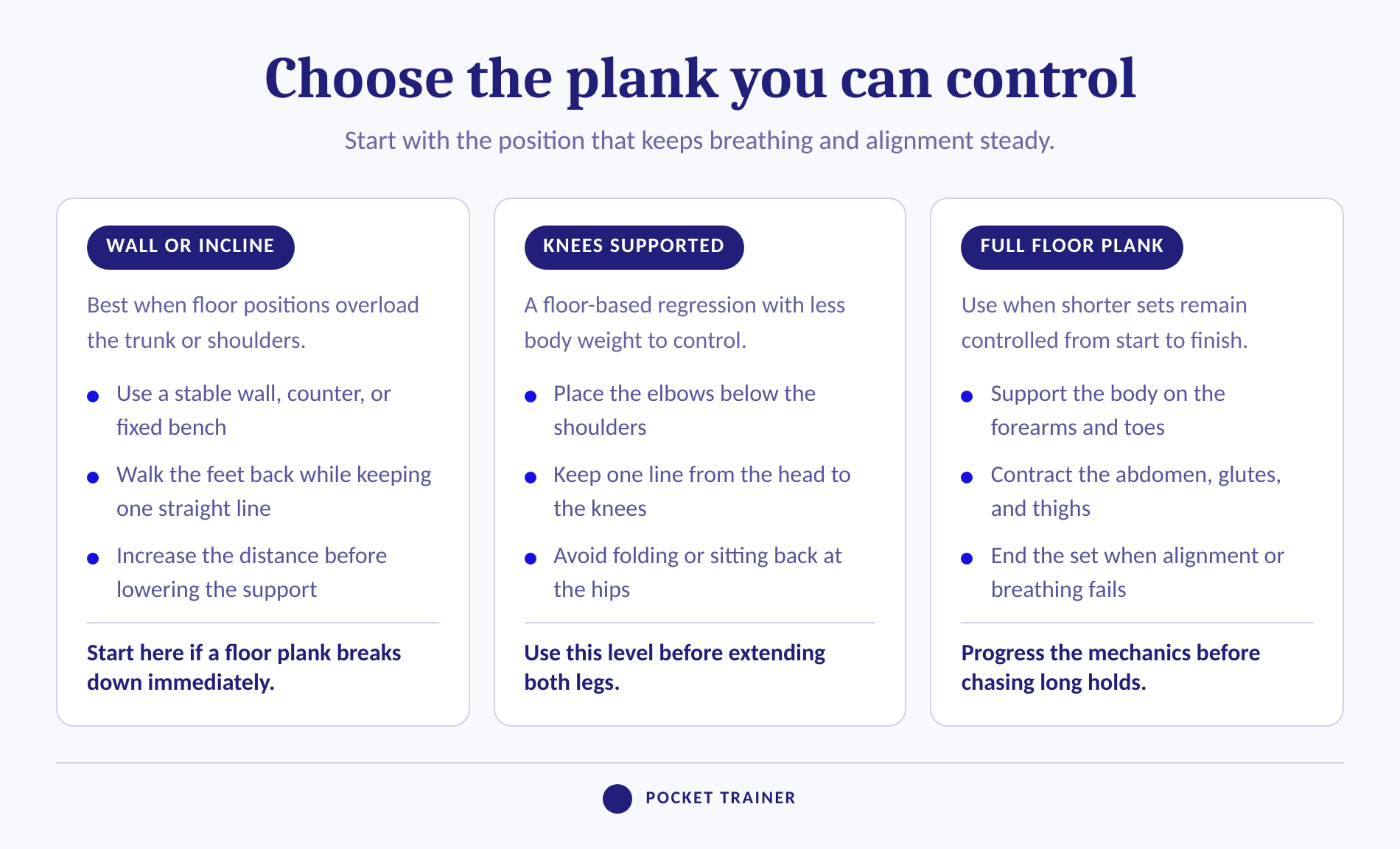
Start with the easiest variation that becomes challenging within a short set while allowing steady breathing and stable alignment. A plank fitness challenge for beginners may begin at a wall or on the knees, while an experienced exerciser may need a full or mechanically harder variation.
A 2024 Mayo Clinic progression presents wall, knee, and full planks as progressively harder options and emphasizes slow, regular breathing. Mayo Clinic's modified-plank guide also places the shoulders above the elbows and keeps the head, neck, and back aligned.
Use these starting options:
- Wall or high incline: Place the hands or forearms on a stable wall, counter, or fixed bench. Walk the feet back until the body forms a straight line. This is the most accessible option when a floor plank immediately disrupts alignment or breathing.
- Forearm plank from the knees: Support the body on the forearms and knees, with the shoulders above the elbows. Keep a straight line from the head to the knees rather than folding at the hips.
- Full forearm plank: Support the body on the forearms and toes. Tighten the abdominal wall, glutes, and thighs while keeping the head aligned with the trunk.
For this template, choose a level that permits two clean sets of 10 to 20 seconds on day 1. Ten seconds is not a failure, and 20 seconds is not a ceiling. The range simply creates enough time to check breathing and alignment without turning the first session into a maximum-effort test.
Stay with the same starting variation during week 1. If 20 seconds is easy, increase tension by pressing the forearms into the floor and contracting the glutes and thighs before extending the set.
A harder position can also increase the demand without a much longer timer. In a 2014 study of 19 participants, a long-lever plank with the elbows farther forward produced more abdominal-muscle activation than a traditional plank during 30-second trials. That finding concerns short-term muscle activation, not superior long-term results or safety, so the variation belongs late in the progression rather than on day 1.
The right starting plank is the version that keeps alignment and breathing intact for every planned set.
What is the 30-day plank fitness challenge schedule?
The calendar uses three work sessions per week, recovery between repeated sessions, and a day-29 comparison at the original level. Progress only one variable at a time: duration, number of sets, or variation difficulty.
| Day or days | Focus | Planned work |
|---|---|---|
| Day 1 | Select and record the starting level | 2 sets of 10 to 20 seconds |
| Day 2 | Recovery | No challenge planks |
| Day 3 | Repeat the base position | 3 sets of 10 to 20 seconds |
| Day 4 | Recovery | No challenge planks |
| Day 5 | Build repeatability | 3 sets of 10 to 20 seconds |
| Days 6 and 7 | Recovery or normal training | No additional plank target |
| Day 8 | Add time if week 1 was clean | 3 sets of 15 to 25 seconds |
| Day 9 | Recovery | No challenge planks |
| Day 10 | Introduce side support | 2 base sets of 15 to 25 seconds, then 2 side-plank sets of 8 to 15 seconds per side |
| Day 11 | Recovery | No challenge planks |
| Day 12 | Repeat the base position | 3 sets of 15 to 25 seconds |
| Days 13 and 14 | Recovery or normal training | No additional plank target |
| Day 15 | Extend controlled work | 3 sets of 20 to 30 seconds |
| Day 16 | Recovery | No challenge planks |
| Day 17 | Base and side support | 2 base sets of 20 to 30 seconds, then 2 side-plank sets of 10 to 20 seconds per side |
| Day 18 | Recovery | No challenge planks |
| Day 19 | Repeat the base position | 3 sets of 20 to 30 seconds |
| Days 20 and 21 | Recovery or normal training | No additional plank target |
| Day 22 | Progress position or time | 3 sets of 20 to 30 seconds at a harder level, or 3 sets of up to 35 seconds at the current level |
| Day 23 | Recovery | No challenge planks |
| Day 24 | Mixed plank session | 3 rounds: base hold for 20 to 30 seconds, then side hold for 10 to 20 seconds per side |
| Day 25 | Recovery | No challenge planks |
| Day 26 | Final training session | 3 sets of 20 to 40 seconds, stopping each set at form loss |
| Days 27 and 28 | Recovery | No challenge planks |
| Day 29 | Repeat the day-1 benchmark | Use the original level and dose; compare form, breathing, and perceived effort without testing to failure |
| Day 30 | Review and choose the next block | No required plank session |
“Base position” means the wall, knee, or full plank selected on day 1. Side planks can also be performed from the knees when a full side plank makes the hips rotate or the shoulder uncomfortable.
Rest for about 60 to 90 seconds between work sets. Take longer when breathing remains elevated, the trunk cannot reset, or the shoulders still feel fatigued. A stopwatch should organize the session, not overrule what the position looks and feels like.
Use the following progression rule:
- Complete every planned set with the same alignment.
- Continue breathing without straining or holding the breath.
- Repeat the performance in the next scheduled session.
- Then add up to five seconds per set or move to the next variation, but not both at once.
If a session is missed, continue with the next scheduled session instead of doubling the volume. If the previous session leaves soreness that changes normal movement or plank technique, repeat the earlier dose or move back one level.
Recovery days do not require complete inactivity. Walking, aerobic exercise, mobility work, or another balanced strength session may still fit the person's program. As of September 2026, the U.S. Department of Health and Human Services continues to list the 2018 second edition as the current Physical Activity Guidelines; those guidelines recommend strengthening all major muscle groups, not concentrating only on the abdomen.
This exact 30-day calendar has not been tested as a named research protocol. It is a conservative synthesis of general resistance-training frequency, official plank instructions, adjustable exercise levels, and planned recovery.
Recovery days and one-variable progression make the calendar sustainable without turning every session into a test.
How should a plank feel and look?
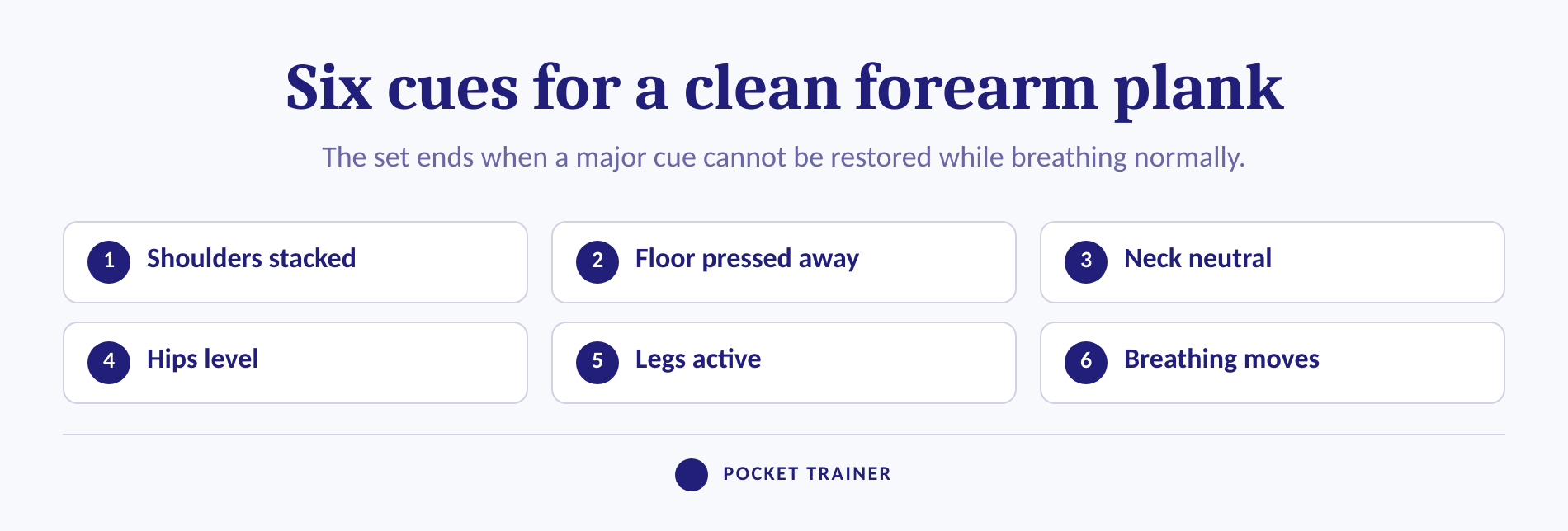
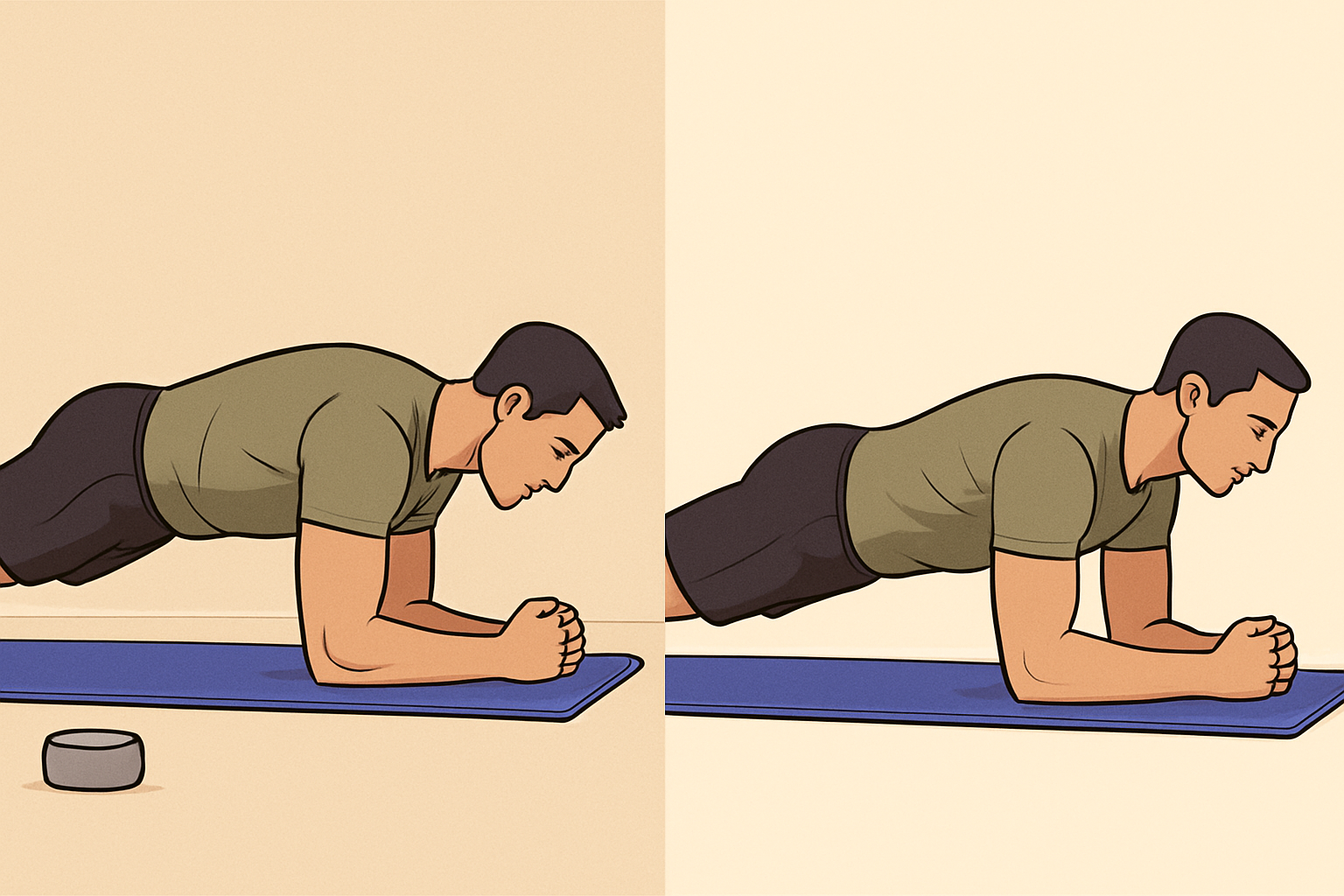
A controlled plank creates muscular effort through the abdomen, glutes, thighs, upper back, and shoulders while normal breathing continues. A plank should not require a sagging lower back, elevated hips, shrugged shoulders, or pain in a joint.
The American Council on Exercise front-plank instructions place the elbows under the shoulders, maintain a stiff torso and legs, discourage sagging or hiking at the hips, and tell the exerciser to continue breathing. Use those points as a six-part check:
- Elbows under shoulders: Avoid reaching so far forward that the shoulders take over, unless a long-lever progression was selected deliberately.
- Forearms pressing down: Push away from the floor rather than sinking between the shoulder blades.
- Head following the trunk: Look toward the floor and keep the neck long instead of lifting the chin.
- Ribs and pelvis controlled: Prevent the lower back from dropping and avoid lifting the hips to escape abdominal effort.
- Glutes and thighs active: Squeeze the glutes and tighten the quadriceps to create full-body tension.
- Breathing still moving: Exhale normally. Breath-holding is not proof that the set is effective.
A mirror, side-view phone recording, or trainer can reveal gradual sagging that is difficult to feel. A recording is a technique check, not a reason to publish or compare someone's body.
End the set when any major checkpoint cannot be restored within one breath. Rest, shorten the next set, or move to an easier position. Do not keep the timer running while resting on the joints or repeatedly correcting a collapsed position.
A plank set is finished when the body can no longer hold the position while breathing normally.
What results can you realistically expect?
The most defensible plank fitness challenge results are improved skill, repeatability, and local muscular endurance in the positions being practiced. Visible abdominal definition, major weight loss, pain relief, and dramatic posture changes are not guaranteed outcomes of a 30-day plank plan.
A 2011 randomized trial assigned 24 sedentary adults to an abdominal-exercise group or a control group. The exercise group performed seven abdominal exercises, two sets of 10 repetitions, five days per week for six weeks. Abdominal muscular endurance improved, but body weight, body-fat percentage, abdominal circumference, abdominal skinfolds, and abdominal subcutaneous fat did not significantly change.
That study did not test planks alone, and 24 participants is a small sample. It cannot predict every person's result. It does show why a claim that one abdominal exercise will specifically burn belly fat is stronger than the available evidence supports.
Muscle-activation research has another limit. The 2014 long-lever study found greater activation during a mechanically harder plank, but surface electromyography records electrical activity during the exercise. It does not by itself prove that the variation produces more long-term strength, better sports performance, less pain, or fewer injuries.
Use day 1 and day 29 to compare outcomes that the challenge actually trains:
- Position: Did the hips and shoulders remain stable for the whole set?
- Breathing: Could normal breathing continue without straining?
- Effort: Did the original dose feel easier on day 29?
- Duration: Could the same position be held slightly longer without form loss?
- Difficulty: Could a harder variation be performed for the original duration?
- Consistency: How many of the 13 planned challenge sessions were completed?
A body-weight or waist measurement may change during 30 days for many reasons, including broader activity and nutrition habits. It should not be presented as proof that the plank challenge caused the change.
The most realistic 30-day result is better plank performance, not guaranteed fat loss or visible abs.
When should you stop or modify the challenge?
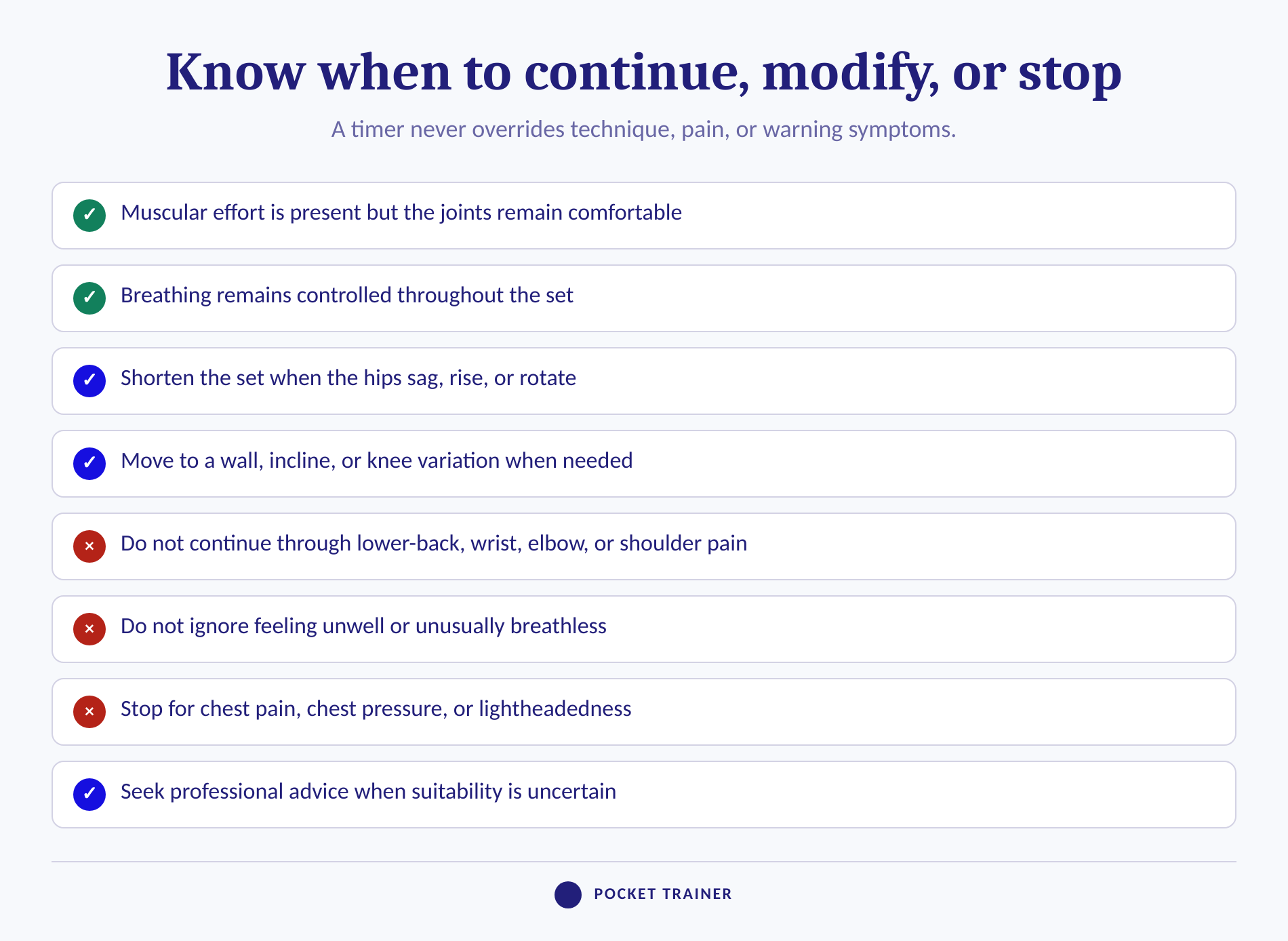
Modify the plank when the selected level prevents normal breathing or stable alignment. Stop the session when pain, feeling unwell, chest symptoms, lightheadedness, or unusual shortness of breath appears.
⚠️ Stop rule: End the set immediately if the lower back, wrist, elbow, or shoulder becomes painful. ACE specifically advises stopping a front plank and consulting a doctor if the movement causes lower-back pain.
Use three response levels:
- Continue: The effort is muscular, breathing remains controlled, joints are comfortable, and alignment is stable.
- Modify: The hips sag or rise, the shoulders shrug, breathing is repeatedly held, or the current level cannot be maintained for the minimum planned set. Shorten the set or move to a wall, incline, or knee variation.
- Stop and seek appropriate advice: Pain is sharp, increasing, or persistent; the person feels unwell; or chest pain, chest pressure, lightheadedness, or unusual shortness of breath occurs. The American Heart Association's 2020 scientific-statement summary advises stopping and seeking medical evaluation for lightheadedness, shortness of breath, or chest pain or pressure.
Severe or sudden symptoms require urgent medical help according to the emergency guidance in the person's location. Finishing a fitness challenge is never more important than responding to a warning symptom.
The NHS exercise safety guidance reviewed in August 2025 recommends getting professional advice before starting when someone has an injury, health problem, symptoms, a recent health event or operation, uncertainty about suitability, pregnancy, or a recent birth. The same guidance says to stop if exercise causes pain or makes the person feel unwell.
Pain, feeling unwell, or cardiovascular warning symptoms end the session; a missed target never justifies pushing through them.
How can trainers adapt the challenge for clients?
Trainers can keep one shared 30-day calendar while assigning different plank levels, durations, and stop rules to individual clients. The group goal should reward appropriate practice and consistency rather than declaring the longest hold to be the best result.
A practical client version can use three parallel tracks:
- Foundation track: Wall, incline, or knee planks with short sets and technique feedback.
- Standard track: Full forearm and modified side planks using the published time ranges.
- Progression track: Harder leverage, controlled shoulder taps, or longer sets for clients who already own the standard positions.
Record the variation as well as the duration. A 30-second wall plank and a 30-second long-lever floor plank are not the same task, so a timer without the exercise level produces misleading comparisons.
A simple weekly check-in can cover four items: sessions completed, variation used, form issues noticed, and symptoms during or after training. If a client reports pain or a health concern, the trainer should stay within professional scope and refer the client to an appropriate healthcare professional instead of diagnosing the problem.
For a group score, award completion only when the selected set meets the agreed technique standard. Consider recognizing consistency, honest modification, and improvement at the same level. Do not reward a participant for extending a visibly collapsed hold.
Trainers should also avoid promising that the plank plan will burn belly fat or produce a particular physique. A challenge can support engagement and measurable exercise practice without attaching an outcome that the exercise alone cannot guarantee.
For clients, the fairest challenge rewards consistent, well-scaled practice rather than the longest raw hold.
What else do people ask about plank challenges?
The common questions focus on whether a plank challenge works and how long a person should hold the position. The consistent answer is that duration only matters when the variation, alignment, breathing, recovery, and broader training program are also appropriate.
Does the 30 day plank challenge really work?
A 30-day plank challenge can improve skill and local muscular endurance in the plank variations being practiced, especially for a beginner. It does not guarantee visible abs, weight loss, better posture, or relief from back pain. Results depend on the starting level, progression, recovery, technique, and the rest of the training program.
Is 2 minutes of plank per day good?
Two minutes can be an appropriate total or continuous hold for some trained people, but it is not a universal standard. A 2026 study found that trained and untrained young adults used some trunk muscles differently during planks held to failure. Stop at form loss, split the time into sets, or choose another variation.
What happens if you do 100 planks a day?
Doing 100 planks a day is not a standard exercise dose because “a plank” may mean a timed hold, a shoulder tap, a knee drive, or another repetition. High volume can turn into repeated poor positions and irritated joints. Use a defined variation, duration, rest interval, and stop rule instead of chasing an arbitrary count.
What will a 1 minute plank a day do?
Holding a clean plank for one minute may improve task-specific endurance if the position is appropriate and still challenging. A daily minute will not reliably produce visible abdominal definition or major weight loss on its own. If form fails before 60 seconds, use shorter sets; if 60 seconds is easy, progress the variation instead.
One or two minutes is not a universal benchmark; the useful dose is the one a person can perform well and progress safely.
What should you do after day 30?
Use the day-29 comparison to choose the next training goal rather than automatically repeating the same calendar. Continue the plank only if it still serves a clear purpose within a balanced program.
The next block might keep the original duration and use a harder variation, combine front and side planks, or replace some plank work with other trunk exercises. General strength training should still address the legs, hips, back, chest, shoulders, and arms rather than allowing one core exercise to dominate the week.
If day 29 looks the same as day 1, that is useful information. Repeat the level, reduce the dose, ask a qualified trainer to check the position, or choose an exercise that fits the person better.
Personal trainers who want a broader app-supported client challenge without creating the workout content or delivery system themselves can ask Pocket Trainer about the Transformation Challenge and decide whether it fits their coaching model.
The best day-30 result is a clearer next training choice, not a promise that one exercise transformed the body.