
In short
The best time for a personal trainer to post Instagram Reels is usually the 30 to 60 minutes before that trainer’s followers are most active, not one universal clock time. If an account has little audience data, start by testing Wednesday noon or 6 p.m., Thursday 9 a.m., and Tuesday 7 p.m. in the audience’s local time.
Key takeaways
📌 Key takeaways
- A September 2026 study of 9.6 million Instagram posts ranked Thursday at 9 a.m., Wednesday at noon, and Wednesday at 6 p.m. as its three strongest overall slots, but it did not isolate Reels from other post formats.
- For a personal trainer, the right posting time is the time that produces profile visits, qualified direct messages, and inquiries from the people most likely to buy coaching.
- Use broad timing data only as a starting hypothesis, then test two consistent time slots for at least four weeks before calling one a winner.
- Compare similar Reels with the same call to action, because changing the hook, topic, and posting time together makes the result impossible to interpret.
Table of contents
- What time is best for Instagram reels?
- Why does a fitness audience need its own posting schedule?
- Where do you find your followers’ active times?
- How do you run a four-week timing test?
- What should you measure after each Reel?
- Frequently asked questions about posting Reels
What time is best for Instagram reels?
For a trainer starting without meaningful account data, test Wednesday at noon or 6 p.m., Thursday at 9 a.m., and Tuesday at 7 p.m. Those are broad Instagram benchmarks, not a promise that every fitness Reel will perform best then.
A September 2026 analysis of 9.6 million Instagram posts put Thursday at 9 a.m., Wednesday at noon, and Wednesday at 6 p.m. at the top overall. It also found that evening engagement was generally strongest from 6 p.m. to 11 p.m. on most weekdays, while Thursday morning was the exception. The important limitation is in the methodology: the analysis combined post formats, so it is evidence for an Instagram starting point, not a Reels-only answer. Read the study methodology. (buffer.com)
| Day | Broad starting time to test | How a trainer can use it |
|---|---|---|
| Monday | 7 p.m. | Test an after-work form cue or a simple workout idea. |
| Tuesday | 7 p.m. | Test a client problem Reel, such as fitting training around a busy schedule. |
| Wednesday | 12 p.m. or 6 p.m. | Reserve for a strong, shareable education or transformation-focused Reel. |
| Thursday | 9 a.m. | Test a practical morning hook, such as a short warm-up or technique correction. |
| Friday | 10 p.m. | Use for lower-stakes content unless account data shows otherwise. |
| Saturday | 9 p.m. | Test lifestyle or routine content rather than the week’s primary lead-generation Reel. |
| Sunday | 9 p.m. | Test planning, meal-prep, or Monday-motivation content. |
All times in the table are local-time benchmarks from the September 2026 study, not rules for a fitness business. A trainer whose best prospects are shift workers, parents, students, or clients in another time zone may see a different pattern.
The useful answer is not “post at 6 p.m. forever.” The useful answer is “use a credible slot to begin, then let account-level results replace the benchmark.”
Why does a fitness audience need its own posting schedule?
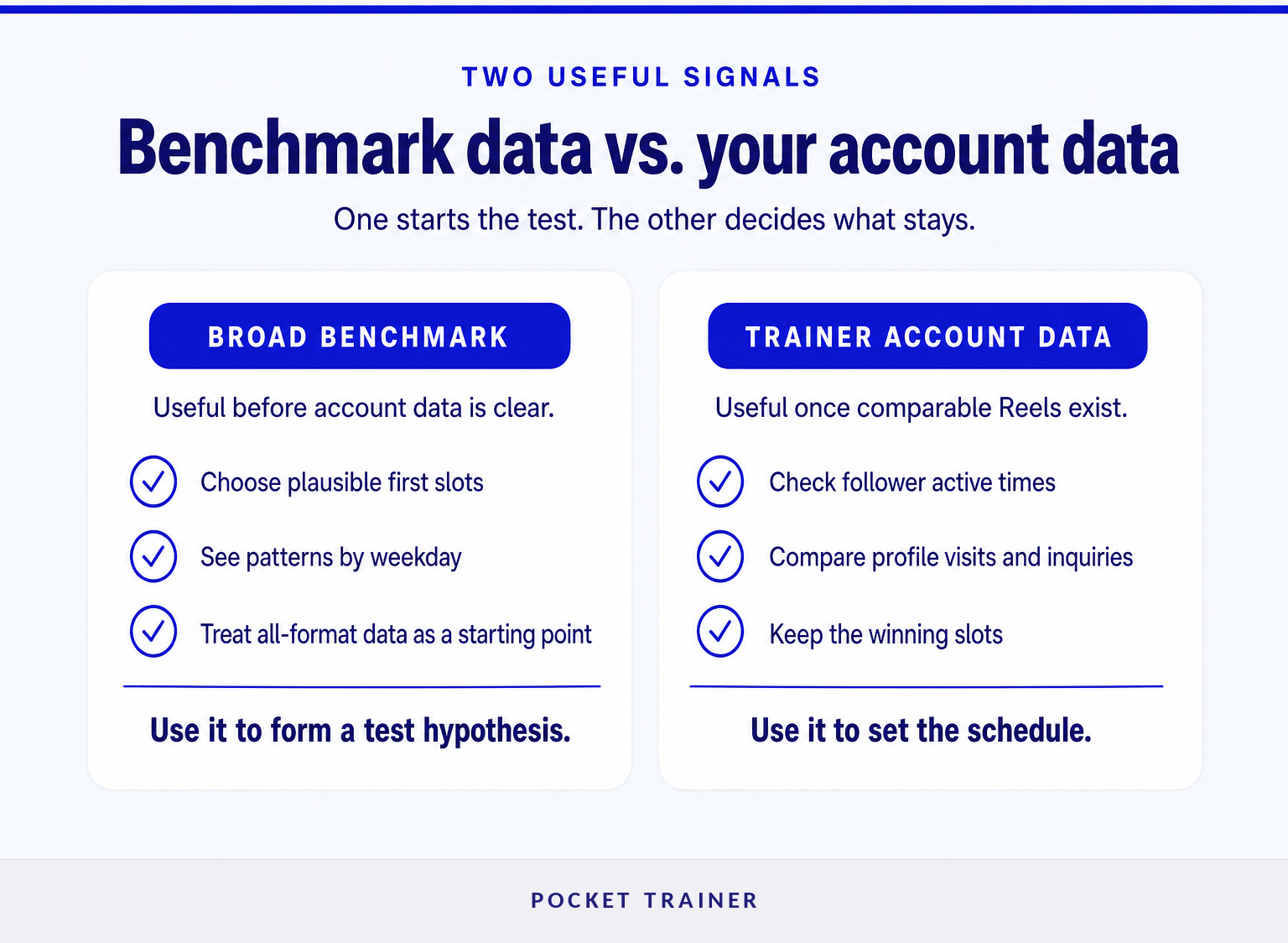
Fitness prospects do not use Instagram at identical times or for identical reasons. A trainer selling remote or hybrid coaching needs to find the moments when the right people have enough attention to watch, visit a profile, and take the next step.
A lunch-break audience may respond to a fast desk-stretch Reel. An after-work audience may be more receptive to a gym-confidence message or a beginner workout explanation. A parent-focused offer may perform after school drop-off or later in the evening. These are hypotheses to test, not behavior patterns to assume.
A trainer should also separate the audience’s time zone from the trainer’s own working hours. If a coach is in one region but serves clients elsewhere, publishing at a convenient local time may miss the audience’s active period. Set the testing schedule around the time zone that represents the largest and most valuable share of prospects.
The phrase “completely different advice about posting times” is a good warning sign. Different studies use different samples, dates, engagement definitions, and post types. Broad data is useful only when it is treated as a hypothesis for the next test.
Your fitness audience deserves its own schedule because a general Instagram average cannot know who is considering coaching from your account.
Where do you find your followers’ active times?
Use Instagram’s native audience activity data before adding more scheduling tools. A professional account can review follower activity through the Professional Dashboard, then use the most active days and hours as test windows.
In the Instagram app, open the profile, select Professional Dashboard, open the follower or audience insights area, and look for the active-times view. Interface labels can change, so use the activity section rather than relying on an old screenshot. The same September 2026 study advises comparing those account-level activity patterns with broad benchmarks rather than treating either one as complete on its own. (buffer.com)
Write down three details before scheduling a Reel:
- The two highest active hours on the days when the account usually posts.
- The account’s primary prospect time zone.
- The time window that has produced the most profile visits or direct-message inquiries in the previous month.
If follower activity is missing or too thin to trust, use the benchmark table above for the first two weeks. Once the account has enough Reel results, performance data becomes more useful than a generic chart.
Native audience activity tells you when followers are online; your own Reel results tell you whether those active people are actually becoming prospects.
How do you run a four-week timing test?
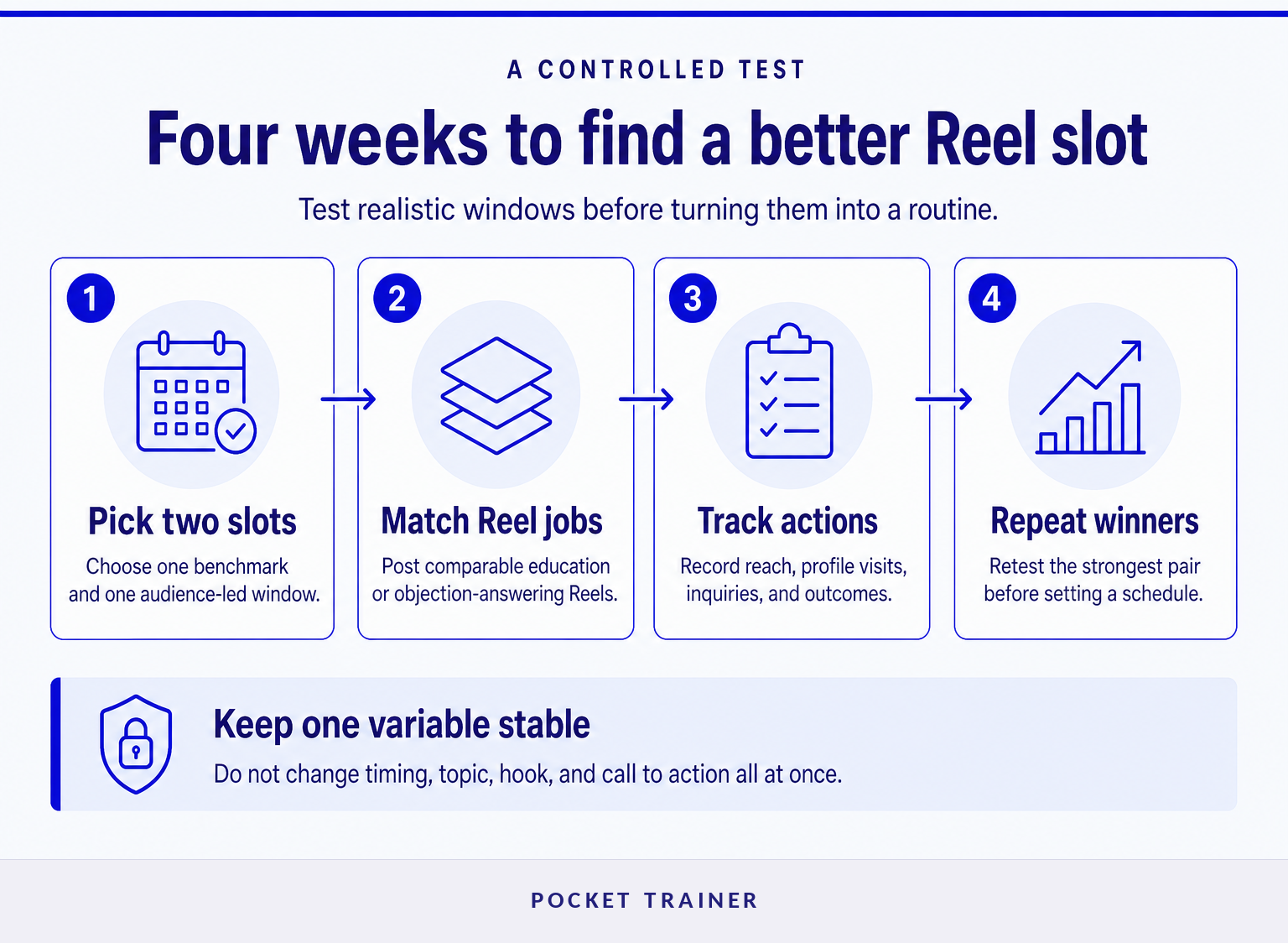
Run a timing test by changing the publishing time while keeping the Reel’s purpose, audience, and call to action as similar as possible. The aim is not to find a magic minute. The aim is to identify a repeatable window that gives good fitness content its best chance to create business results.
Week 1: Set two realistic time slots
Choose two slots that fit both the benchmark and the account’s active-times view. For example, a trainer could test Wednesday at 6 p.m. and Thursday at 9 a.m. Do not choose a time that cannot be repeated consistently because the test needs comparable posts.
Week 2: Publish the same kind of Reel at each slot
Use two Reels with a similar job. Good pairs include two exercise-form corrections, two beginner-workout myths, or two short answers to common client objections. Keep video length, caption style, and call to action broadly comparable.
Week 3: Add one audience-led slot
Post 30 to 60 minutes before one of the account’s highest follower-activity periods, then compare it with the broad benchmark. This timing buffer is a practical starting point, not a platform guarantee. (buffer.com)
Week 4: Repeat the strongest pair
Repeat the two time slots that produced the most promising results. Do not crown a winner from one unusually viral Reel. Compare at least several similar posts, then use the middle result rather than letting one outlier decide the schedule.
A simple tracking sheet can include date, local posting time, topic, Reel length, reach, shares, profile visits, direct messages, and booked-call or application outcomes. If the business does not take calls, substitute the next meaningful action, such as a checkout visit or program inquiry.
A good timing test changes one meaningful variable at a time, so the trainer learns something usable instead of collecting a pile of unrelated Reel results.
What should you measure after each Reel?
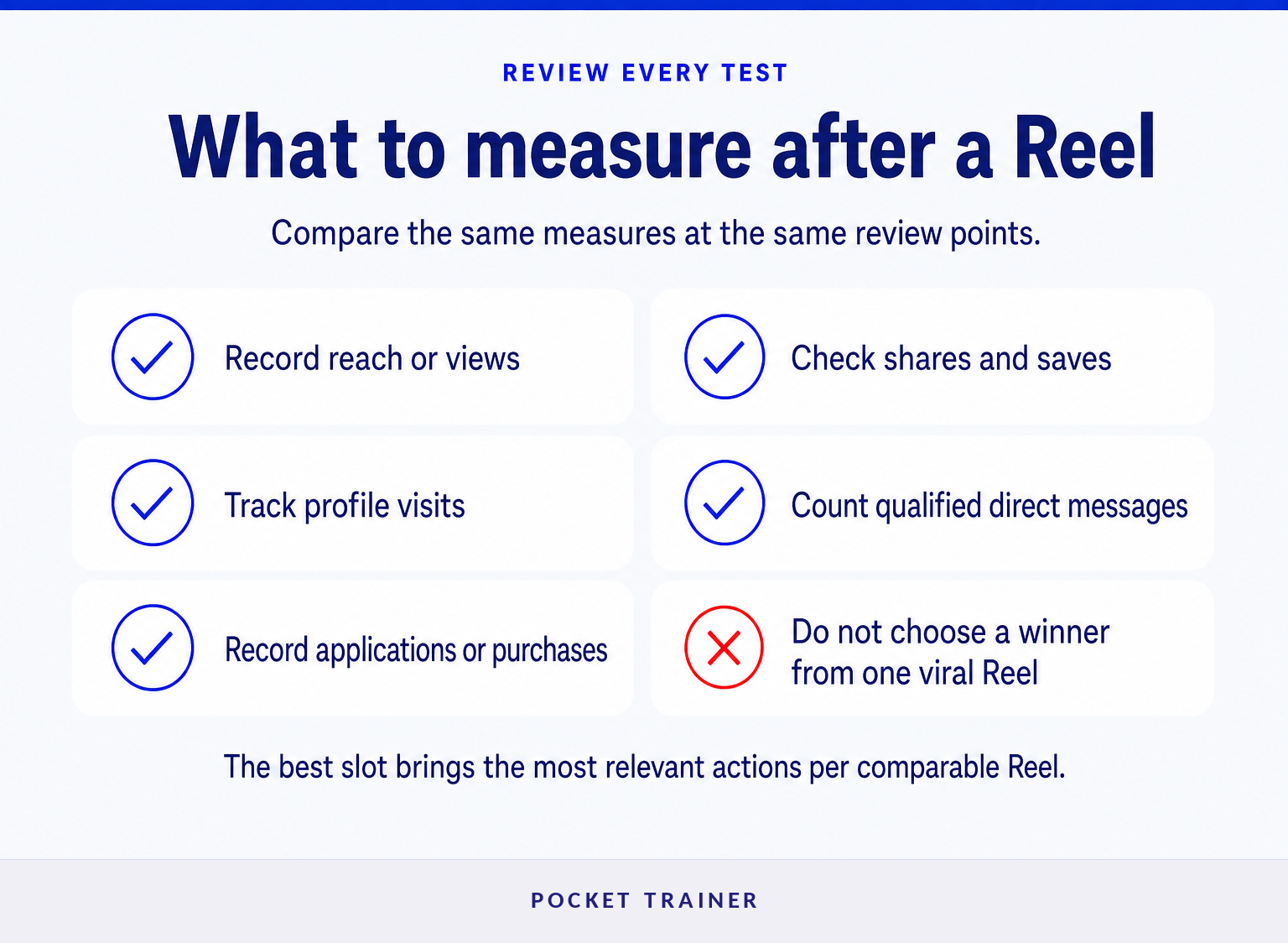
Views can show that a Reel traveled, but views alone do not show whether the Reel reached viable coaching prospects. Measure attention, interest, and action in that order.
Start with reach or views to see how widely the Reel was distributed. Then check engagement signals that indicate interest, especially shares, saves, comments that show genuine relevance, and profile visits. Finally, record business actions: qualified direct messages, program questions, application starts, or purchases where those are available.
Use the same review points for every tested Reel, such as 24 hours and seven days after posting. A Reel can continue reaching people after the first day, while a trainer still needs an early, consistent snapshot for fair comparisons.
A useful winner is the time slot that brings the most relevant actions per Reel, not simply the biggest view count.
If more Instagram attention is creating more questions than a trainer can manage manually, Pocket Trainer’s trainer social-growth support can help connect content activity with a ready-made client experience, sales-page setup, and follow-up support. The next action is to choose one test pair and publish the first two comparable Reels this week.
Frequently asked questions about posting Reels
These answers address common timing questions, but each one should lead back to the same decision: use broad patterns as a starting point and validate them against the audience a trainer wants to serve. Posting time is a controllable variable, not a substitute for a clear Reel and a relevant offer.
What is the 5-3-1 rule on Instagram?
The 5-3-1 rule is an informal content-planning idea, not a universal Instagram timing rule. Different creators use the phrase for different mixes of educational, personal, and promotional posts. For personal trainers, define the content mix clearly, then test posting times separately so the two decisions do not get confused.
What is the golden hour on Instagram?
The golden hour on Instagram is the period when a specific account’s most valuable audience is most likely to be active and responsive. It is not the same clock hour for every trainer. Use native follower activity as a starting point, then confirm the window through Reel reach, profile visits, and qualified inquiries.
What time is best for Instagram reels?
A broad September 2026 benchmark suggests starting with Wednesday at noon or 6 p.m., Thursday at 9 a.m., and Tuesday at 7 p.m. for Instagram overall. Because the study combines post formats, personal trainers should test those windows against their own follower activity and client-inquiry results before making a fixed schedule. (buffer.com)
What is the best time to post an Instagram Reel today?
The best time to post an Instagram Reel today depends on the day, the audience’s time zone, and the account’s active-times data. For example, on Wednesday, October 7, 2026, the broad benchmark starts with noon, followed by 6 p.m. and 8 a.m. Use your own Insights before treating that schedule as final. (buffer.com)
The best posting time is the one that repeatedly puts a useful Reel in front of the people most likely to trust the trainer, visit the profile, and ask what working together looks like.