
In short
In the United States, the closest current federal benchmark for personal trainers is $22.67 per hour or $47,160 per year, the May 2025 BLS median published in August 2026. Actual earnings vary widely, and self-employed or online client payments are business revenue, not take-home pay after fees, expenses, and taxes. (bls.gov)
Key takeaways
- The May 2025 BLS median for exercise trainers and group fitness instructors was $22.67 per hour or $47,160 per year. (bls.gov)
- The lowest-paid 10 percent earned less than $28,800, while the highest-paid 10 percent earned more than $83,100. (bls.gov)
- Indeed reported an average advertised base salary of $31.10 per hour, based on 54,300 salary records from job postings and updated August 31, 2026. (indeed.com)
- BLS wage estimates exclude self-employed workers, so they cannot show the take-home earnings of an independent training business. (bls.gov)
- When Pocket Trainer handles billing, its current 10% fee leaves 90% of billings before other expenses and taxes; trainers can alternatively collect payments themselves. (pocket-trainer.co)
Table of contents
- How much does a personal trainer earn in the United States?
- Why do salary websites give different answers?
- How much is that per month, week, and hour?
- How is self-employed trainer income different from a salary?
- How can online services affect personal trainer income?
- What does an online income example look like after fees?
- What factors change wages for a personal trainer?
- What else do people ask about personal trainer earnings?
- What should you do next?
When someone asks how much does a personal trainer make, the useful answer starts by identifying the income model. Wages for a personal trainer employed by a gym are not the same as client payments received by an independent trainer, and neither figure is the same as recurring online revenue.
How much does a personal trainer earn in the United States?
The closest official U.S. benchmark is $22.67 an hour and $47,160 a year. Those are the May 2025 median wages for exercise trainers and group fitness instructors, published by the U.S. Bureau of Labor Statistics on August 27, 2026. (bls.gov)
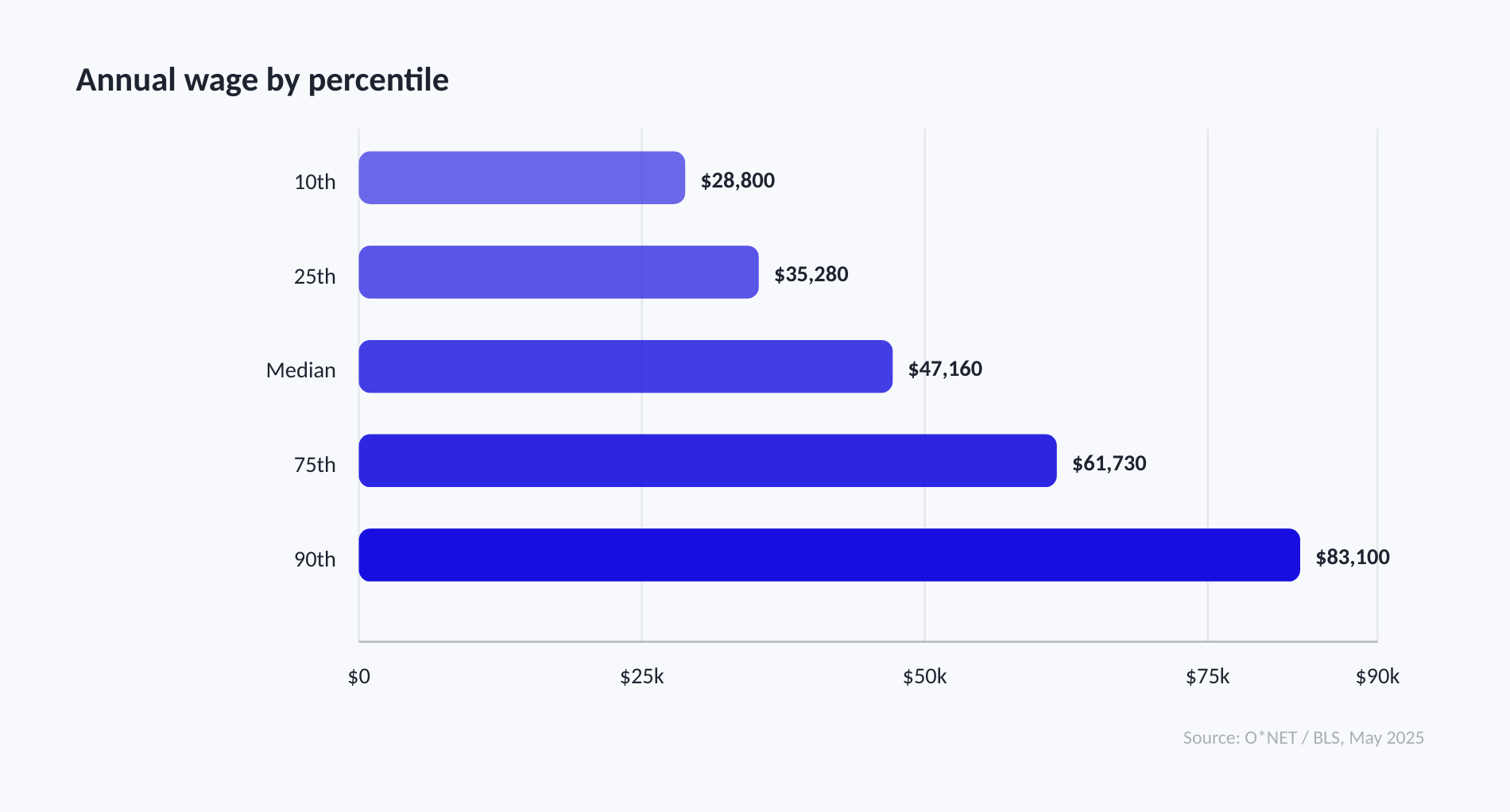
O*NET's 2025 national wage table places the 10th percentile at $28,800, the 25th at $35,280, the median at $47,160, the 75th at $61,730, and the 90th at $83,100. Percentiles describe the wage distribution. They do not prove that every new trainer starts at the 10th percentile or that experience alone moves a worker to the 90th. (onetonline.org)
The federal category also includes group fitness instructors, so it is broader than the job title “personal trainer.” More importantly, BLS wage estimates do not include self-employed workers. The figures are a defensible starting point for employee wages, not a complete answer for private trainers or online businesses. (bls.gov)
The most defensible U.S. benchmark is $22.67 an hour or $47,160 a year, but it does not cover self-employed trainers.
Why do salary websites give different answers?
Salary websites can report different numbers without either number being false. The sources may measure different job titles, worker populations, time periods, and types of pay.
| Source | Latest reported figure | What it measures | Main limitation |
|---|---|---|---|
| BLS, May 2025 | $22.67 hourly median; $47,160 annual median | Wage and salary workers in a broad federal occupation | Includes group instructors and excludes self-employed workers |
| Indeed, August 31, 2026 | $31.10 average hourly base salary | 54,300 salary records from personal trainer job postings over 36 months | Advertised and reported posting data are not the same as a worker wage survey |
Indeed's personal trainer salary page also showed a reported low of $18.23 and high of $53.07 per hour as of August 31, 2026. Those endpoints describe Indeed's posting-based range, not a guaranteed minimum or maximum for the occupation. (indeed.com)
Do not average the BLS and Indeed figures together. Use BLS as a broad occupational benchmark, Indeed as a current view of advertised base rates, and actual local offers as evidence of what a specific employer will pay.
A trainer comparing jobs should also ask how commissions, floor duties, package sales, cancellations, and benefits are handled. A high session rate can produce modest total earnings if only a small share of the working week is paid at that rate.
Salary figures differ because they measure different worker groups, time periods, and data types.
How much is that per month, week, and hour?
The $47,160 BLS annual median equals $3,930 per month or about $907 per week when divided evenly across a year. Those are gross planning conversions, not promises of a stable monthly paycheck.
Many trainers work variable or part-time schedules, according to BLS. Some also spend time selling sessions, monitoring equipment, handling front-desk tasks, preparing programs, or traveling to clients. Compensation for those duties depends on the employment arrangement. (bls.gov)
For example, $22.67 multiplied by 25 paid hours a week produces $566.75 in gross weekly wages. At 50 working weeks, that would be $28,337.50 for the year. This is a hypothetical schedule, but it demonstrates why multiplying an hourly rate by 40 hours can overstate likely earnings when only booked sessions or classes are paid at the headline rate.
Before accepting an employee role, ask:
- How many paid hours do established trainers normally receive?
- Are programming, sales, meetings, and floor shifts paid separately?
- What happens financially when a client cancels?
- Are commissions included in the advertised rate?
- Does the role provide health insurance, paid leave, or retirement contributions?
Monthly and weekly figures are planning conversions, not promises of steady pay.
How is self-employed trainer income different from a salary?
A self-employed trainer receives business revenue rather than an employee salary. Client payments must cover operating expenses and taxes before the remainder becomes personal take-home income.
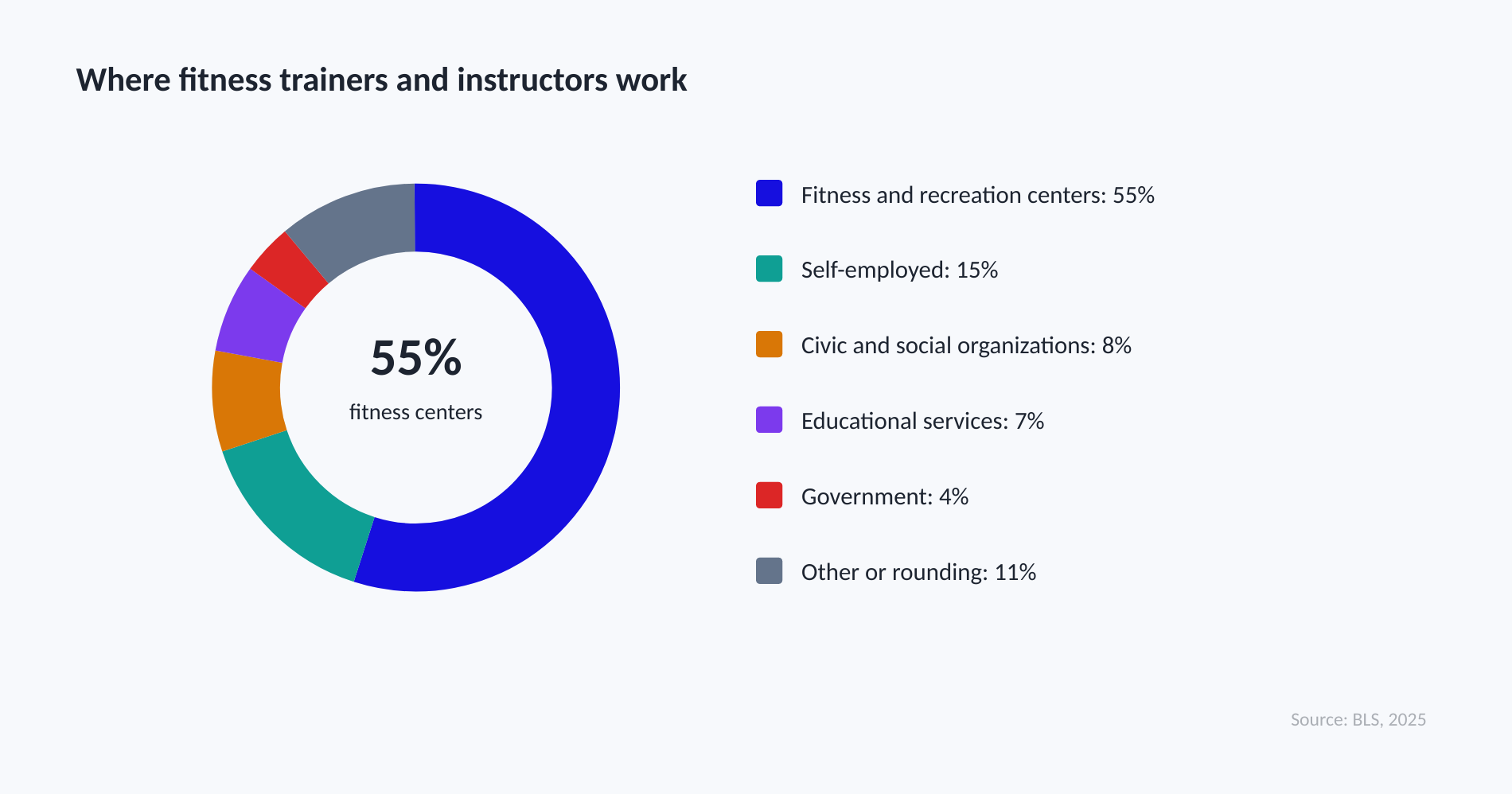
BLS reports that fitness and recreational sports centers accounted for 55% of jobs in 2025. Self-employed workers represented 15%, civic and social organizations 8%, educational services 7%, and government 4%. The remaining 11% in the chart is the calculated balance after the listed categories. (bls.gov)
The IRS self-employed individuals tax center explains that net profit is calculated by subtracting business expenses from business income. Self-employed people generally file an annual return and may also need to make estimated tax payments during the year. (irs.gov)
A trainer's possible expenses may include:
- Gym rent, a floor fee, or a facility's share of client payments
- Professional liability insurance and business licenses
- Certification renewal and continuing education
- Equipment, travel, software, and phone costs
- Advertising, sales, accounting, and payment-processing fees
- Unpaid programming, communication, administration, and client acquisition time
The exact tax result depends on business structure, deductions, total income, filing status, and jurisdiction. A gross-revenue forecast should not be treated as tax advice or as a take-home estimate.
A self-employed trainer earns revenue first and reaches personal take-home pay only after costs and taxes.
How can online services affect personal trainer income?
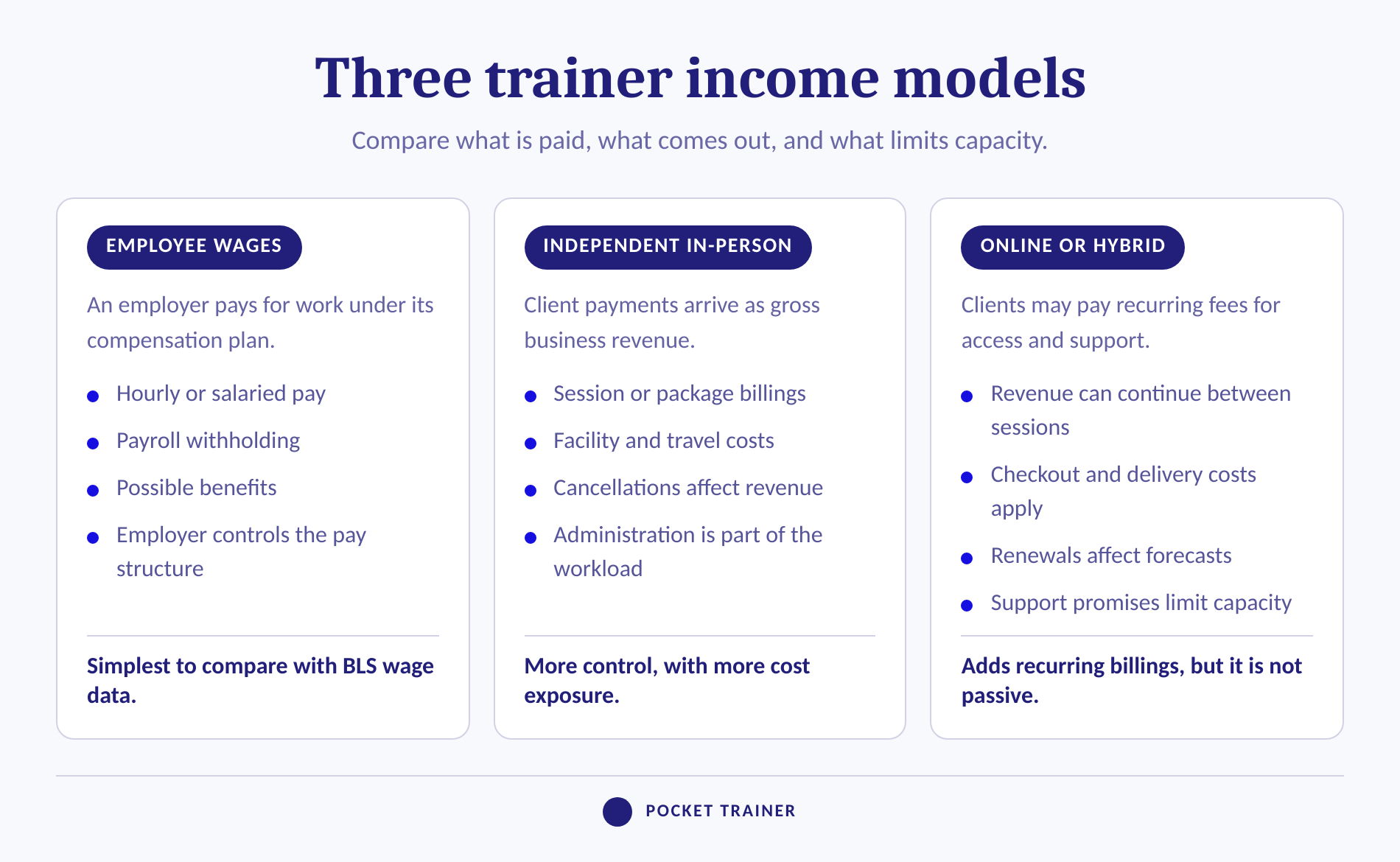
An online service can add recurring billings that are not tied to one scheduled gym session at a time. The model is not passive, because programming, communication, progress review, retention, and client support still require time.
The unit of sale changes. An employed trainer commonly sells working time to an employer. An independent in-person trainer sells sessions or packages. An online or hybrid trainer may sell continuing access to workouts, guidance, messaging, and progress support.
The basic equations are:
Annual online billings = active paying clients × amount billed per client each year
Pre-tax business profit = billings − checkout fees − refunds − operating costs
The service promise determines capacity. A highly personalized package with frequent live contact can remain time-intensive. A more standardized service can reduce repeated delivery work, but only if clients still receive the support promised in the offer.
Pocket Trainer supplies a client app, workout library, customizable plans, messaging, progress monitoring, and a trainer sales page. It is designed for trainers who prefer not to build their own app or record an original workout-video library. (pocket-trainer.co)
Online services change the unit of sale from only booked sessions to recurring access plus support.
What does an online income example look like after fees?
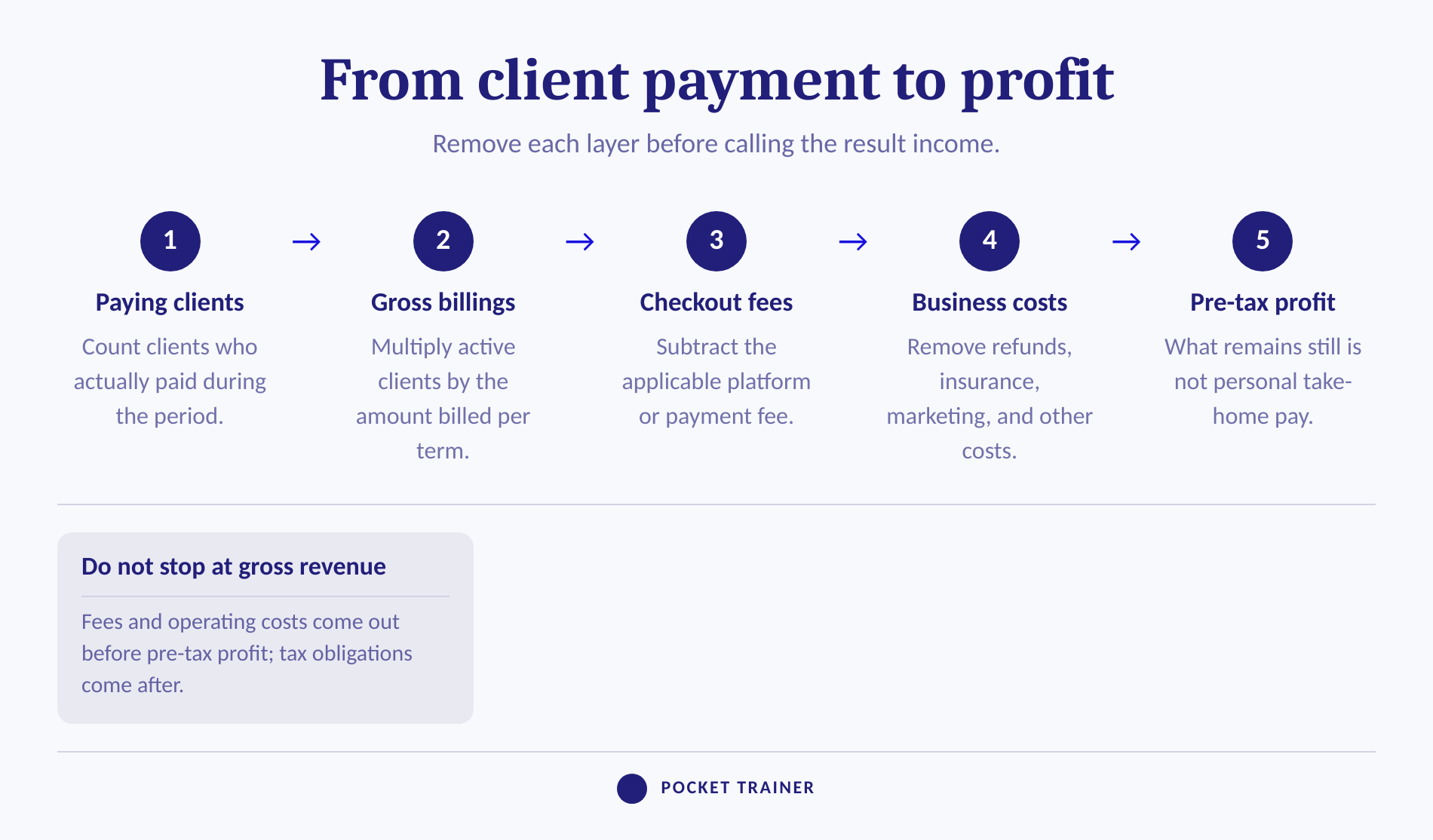
A useful online income example starts with billings and removes each cost in order. The following scenario illustrates the calculation rather than predicting what a trainer will earn.
Trainers considering content creation as an additional online-income path may also find this practical guide to faceless YouTube channels useful for understanding how AI can support the creator process.
Pocket Trainer currently publishes a pricing example of $299 every six months. Its optional checkout retains 10%, while trainers who collect payments directly do not pay that Pocket Trainer checkout fee. The site rounds the checkout payout on $299 to $270; the exact 90% calculation is $269.10. (pocket-trainer.co)
🧮 Hypothetical 20-client example
- Annual gross billings:
20 clients × $299 × 2 billing periods = $11,960 - Pocket Trainer checkout fee:
$11,960 × 10% = $1,196 - Revenue after that checkout fee:
$11,960 − $1,196 = $10,764 - Average after-fee amount across 12 months:
$10,764 ÷ 12 = $897
The $10,764 figure is still not salary or take-home pay. Insurance, marketing, refunds, equipment, accounting, other software, and the value of delivery and support time may still need to come out. Federal, state, and local tax obligations may then apply to the resulting profit.
Direct payment collection removes Pocket Trainer's 10% checkout fee, but a trainer may still incur charges from the chosen payment method. Direct collection also transfers billing administration and payment follow-up to the trainer.
A reusable online-income worksheet should track active paying clients, average billed revenue per client, renewal rate, refunds, checkout fees, operating costs, and total delivery hours. One useful final measure is:
Effective pre-tax hourly return = profit before tax ÷ total delivery and administration hours
Count online income only after checkout fees, operating costs, unpaid support time, and taxes.
What factors change wages for a personal trainer?
Location, compensation structure, paid utilization, client retention, and business expenses can change earnings substantially. No certification or online platform guarantees a particular income.
Location matters, but statewide figures still hide differences between cities and employers. The Department of Labor's 2025 California wage table reported a $57,990 statewide median, compared with the $47,160 national median. Its Texas wage table reported a $40,880 median. Both use the broader federal occupation and exclude self-employed workers. (cloudfront.careeronestop.org)
The biggest variables to model are:
- Paid utilization. A trainer may be available for 40 hours without receiving a full 40 hours of session-rate pay.
- Compensation structure. Base pay, session pay, commissions, package sales, floor duties, and benefits can produce different total compensation from the same advertised rate.
- Client retention. Independent and online income falls when clients cancel or do not renew, even if the listed price remains unchanged.
- Local demand and positioning. A statewide median cannot reveal what a particular neighborhood, audience, or employer will support.
- Certification and access to work. BLS says employers generally prefer certification and that personal trainers usually need certification before working with clients. That supports access to jobs, but the federal data do not establish a guaranteed salary premium for any credential. (bls.gov)
- Service design and costs. More client contact may support a higher price while also limiting the number of clients one trainer can serve.
Location, pay structure, paid utilization, retention, and service design usually matter more than a headline hourly rate.
What else do people ask about personal trainer earnings?
Most related questions come down to age, entry requirements, and whether likely income will cover local living costs. A national wage benchmark helps, but it cannot replace a local budget and a realistic estimate of paid hours.
Do personal trainers make good money?
Personal training can provide a solid income, but “good money” depends on hours, location, employer, client demand, and business costs. The May 2025 BLS median was $47,160 a year, while the top 10 percent earned more than $83,100. Self-employed revenue is not directly included in that wage measure. (bls.gov)
Is 40 too old to become a PT?
Forty is not automatically too old to become a personal trainer. The BLS career profile lists education, certification, first aid, communication, and physical fitness as relevant preparation, not a maximum starting age. The practical questions are whether the schedule, physical demands, training requirements, and likely local income fit the person. (bls.gov)
Is it hard to become a personal trainer?
Entry requirements are accessible compared with many regulated professions, but becoming employable still takes study and practical skill. BLS says a high school diploma is typical, employers often prefer certification, and personal trainers usually need certification before working with clients; CPR, first aid, and AED credentials are also commonly needed. (bls.gov)
Can you live off being a personal trainer?
Some personal trainers live on training income alone, but the answer depends on paid hours, local living costs, cancellations, benefits, and business expenses. Use the $47,160 BLS median only as a wage benchmark. A self-employed trainer should build a budget from expected client revenue minus costs and taxes. (bls.gov)
Personal training can support a living, but the budget has to work at the trainer's actual hours and costs.
What should you do next?
Build three income scenarios before using any salary figure to make a career decision. Each scenario should use conservative paid-hour or client-retention assumptions and show the money remaining after costs.
| Scenario | Start with | Then account for |
|---|---|---|
| Employee | Hourly rate × realistic paid hours | Commissions, payroll deductions, benefits, and unpaid gaps |
| Independent trainer | Session and package revenue | Facility costs, cancellations, insurance, administration, and taxes |
| Hybrid or online trainer | In-person income plus recurring client billings | Checkout fees, renewals, refunds, support time, operating costs, and taxes |
Next step: If a ready-made remote service is the selected path, run the Pocket Trainer trainer platform through the same margin worksheet. Confirm the current terms, choose between direct payment collection and the optional checkout, and book a setup call only if the post-fee service can be delivered at the support level promised to clients.
Build a one-page income model before treating any salary figure as a career forecast.