
In short
Gamifying exercise means adding a clear goal, visible progress, timely feedback, and an optional social or reward layer to a workout plan. For personal trainers, the useful version is not gimmicks: it is a simple challenge system that makes the next action obvious while keeping training safe, personal, and measurable.
- 🎯 A 2024 systematic review found that gamified health apps produced a modest average increase of 489 steps per day versus non-gamified versions, not a guarantee of dramatic results for every client. Read the review
- 📈 The best gamification workout starts with one behavior a client can control, such as completing planned sessions or logging a walk.
- 🤝 Leaderboards are optional because public comparison can discourage clients who are new, returning after a break, or far from the group’s baseline.
- 🏆 Rewards should recognize consistent, safe actions rather than pain tolerance, extreme restriction, or the fastest body transformation.
- 🔁 A challenge needs a review point, because trainers should keep, adapt, or remove mechanics based on client behavior rather than assumptions.
Contents
- What does gamifying exercise actually mean?
- How can a trainer gamify exercises without turning every session into a contest?
- Which game mechanics fit different clients?
- How should a trainer build a gamification workout clients can actually follow?
- When should rewards-prizes-and-leaderboards-be-used-carefully?
- How do you measure whether gamified workouts are helping?
- What else do trainers ask about gamifying exercise?
A gamified workout is not an exercise routine with random points pasted on top. It is a coaching structure that gives clients a short-term target, a way to see progress, and a reason to return for the next action. The trainer still owns the important work: appropriate programming, technique guidance, progression, and adjustments when a client is struggling.
What does gamifying exercise actually mean?
Gamifying exercise means using selected game elements in a non-game setting, such as goals, progress bars, levels, streaks, team challenges, or rewards. In coaching, those elements should make an existing training behavior easier to notice and repeat, not distract from the training plan.
A 2022 systematic review found that goal-setting, progress bars, rewards, points, and feedback were among the most common elements in physical-activity gamification research. The review also found mixed results and generally modest changes, which is a useful warning against presenting gamification as a substitute for good coaching or a client-ready plan. Read the systematic review
For trainers, four practical types of gamification cover most use cases:
- Progress gamification uses visible completion, streaks, milestone cards, or a percentage bar.
- Challenge gamification turns a large goal into small missions, such as three strength sessions this week.
- Social gamification adds a teammate, group target, shared check-in, or carefully matched competition.
- Reward gamification gives recognition, a badge, a prize entry, or another agreed incentive after a defined action.
These are working categories for planning a client experience, not a universal scientific taxonomy. A client does not need all four. One clear mechanic is usually easier to explain, run, and evaluate than an elaborate points system.
The useful question is not, “How do I make exercise feel like a video game?” It is, “What action does this client need help repeating this week?”
How can a trainer gamify exercises without turning every session into a contest?
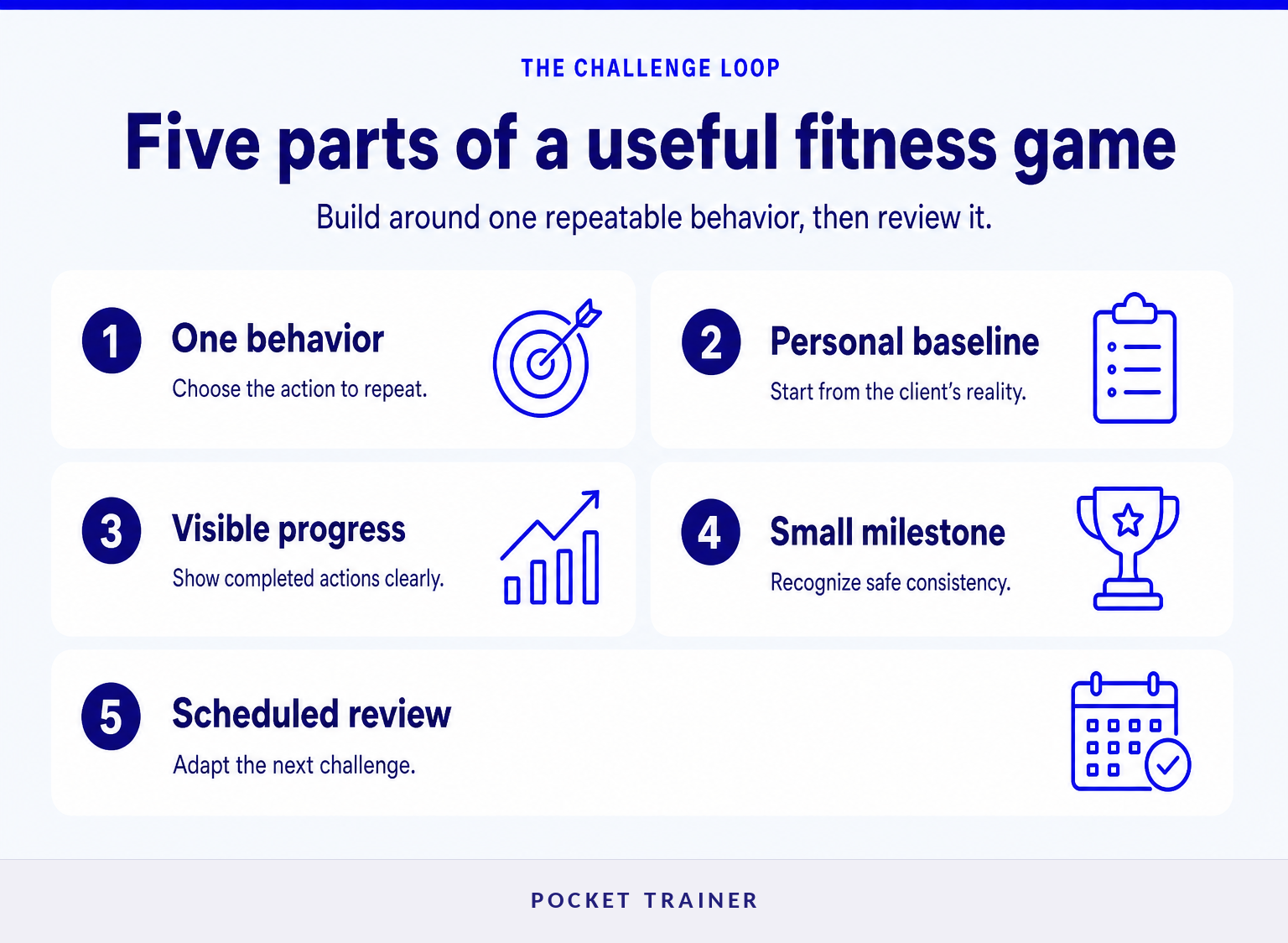
Start with an individual challenge loop: one behavior, one visible measure, one next milestone, and one check-in. This keeps the experience focused on the client’s own starting point instead of making every workout a public contest.
For example, a client returning to exercise might earn a completed-session marker after each planned workout, with a milestone after three sessions. A more experienced client might work through a four-week strength quest, where each week has a specific training target and a review. Neither format requires a leaderboard.
Make the score reflect actions a client can safely control. Good examples include completing a scheduled session, submitting a check-in, practising a programmed movement, or taking a planned recovery day. Avoid awarding points for training through pain, using drastic food restriction, or chasing volume that does not match the program.
For clients who need a gentler entry point, build missions around consistency and confidence first. A trainer can adapt principles from fitness challenges for beginners by offering scaled movement options, a realistic completion target, and a reset rule after a missed day.
A gamified workout should make the next useful action clearer, not make clients feel as though they have failed when life interrupts the plan.
Which game mechanics fit different clients?
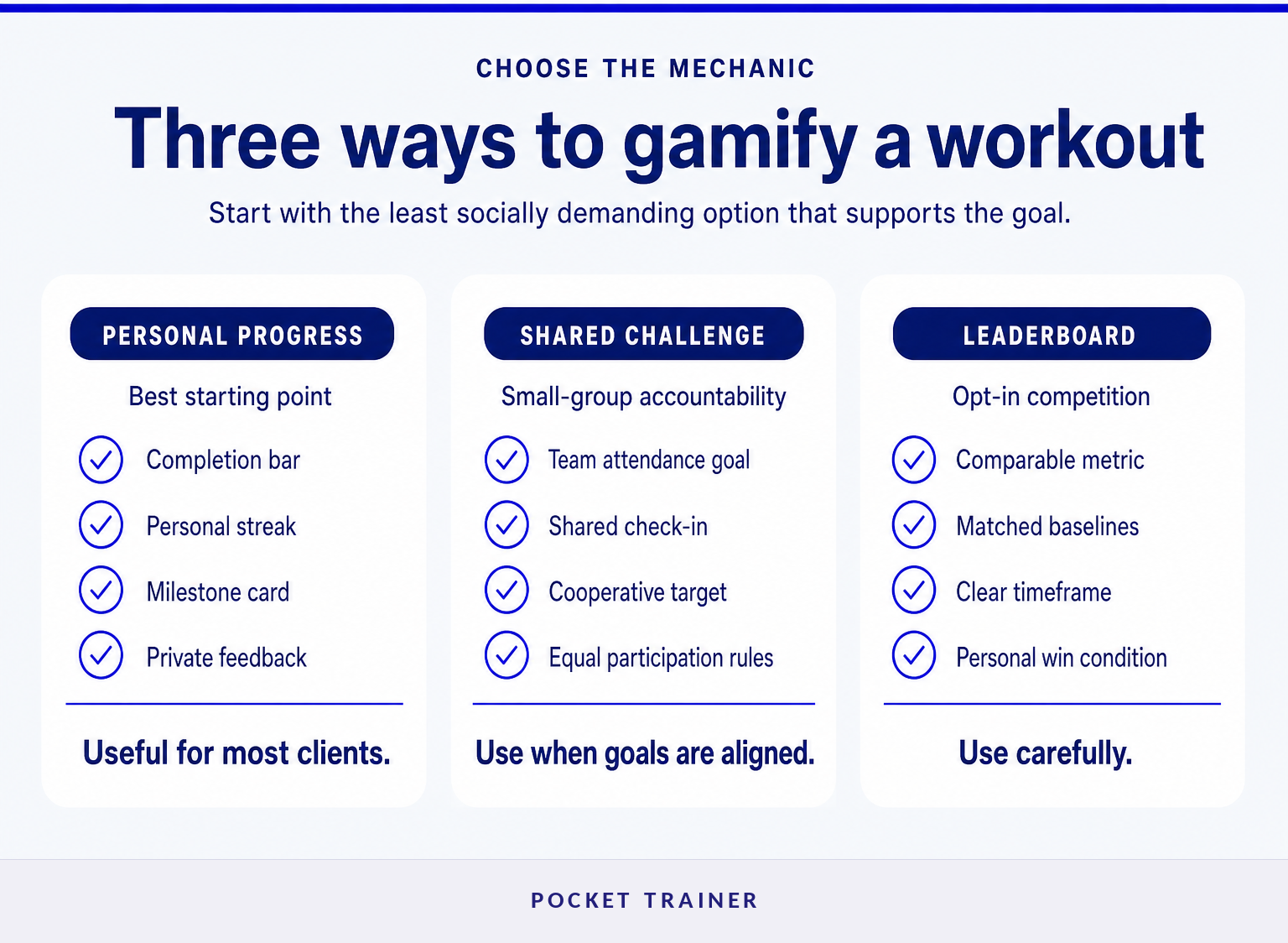
The right mechanic depends on the client’s confidence, goal, schedule, and relationship with comparison. Progress tracking works for many clients because it shows movement without ranking anybody; competition needs more care.
A client who has a stop-start exercise history may respond best to a short streak, a weekly completion bar, or a personal-best log. A client who likes structure may prefer a mission sequence with clear stages. A small group with similar ability and goals may enjoy a shared target, such as collectively completing a set number of workouts or walks.
Competition is not automatically motivating. A 2017 analysis of walking challenges found that activity gains were weaker when competitors were very unevenly matched. That makes baseline grouping more important than a large, open leaderboard. Read the large-scale walking-challenge analysis
Use a leaderboard only when clients have agreed to it, the comparison is relevant, and the score is fair. For example, compare weekly adherence percentages rather than total weight lifted when clients have different programs, experience levels, or equipment access.
A useful rule is to give every client a personal win condition, even inside a group challenge. The client who completes two planned workouts should be able to succeed without needing to outperform somebody who trains six days a week.
The best game mechanic is the one that supports the client’s actual reason for training, rather than the one that creates the most noise.
How should a trainer build a gamification workout clients can actually follow?
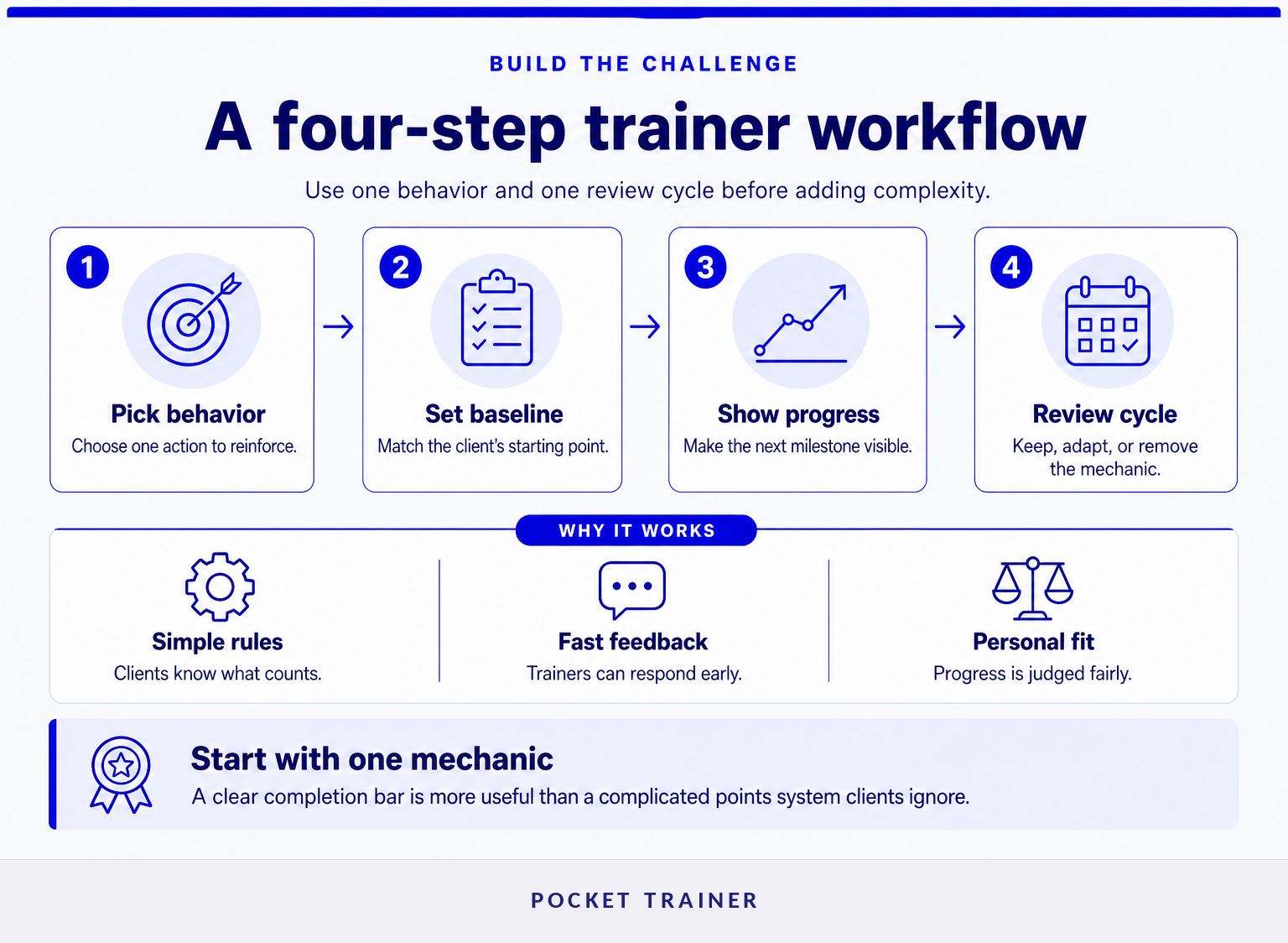
Build a gamification workout around a short cycle that clients can understand in under a minute. Four weeks is often long enough to create a meaningful pattern and short enough to review before the rules become stale.
1. Choose one behavior. Pick the behavior that matters most right now: completing two strength workouts, logging three walks, sending a weekly check-in, or practising a specific movement. Do not run several scoring systems before a client has learned the first one.
2. Establish a starting point. Use the client’s current schedule, experience, limitations, and available equipment. A baseline makes the challenge personal and prevents a low-volume beginner from being measured against a highly trained client.
3. Make progress visible. Give clients a simple way to see completed actions and the next milestone. Pocket Trainer states that its client app lets trainers set goals, send messages, and track client progress, which can support a clear feedback loop without requiring trainers to build their own exercise-video library or app.
4. Review and reset. At the end of the cycle, ask what the client completed, what caused friction, and whether the next challenge should be easier, harder, or different. The review is where gamification becomes coaching rather than a generic template.
If the trainer needs a format to place inside the challenge, ideas for exercise challenges can help match the mechanic to a workout theme. A simple plank fitness challenge can also work when it is scaled to the client’s current ability and supported by form guidance.
Pocket Trainer also promotes an ongoing Transformation Challenge. Its site states that the challenge has a $10,000 prize pool split into $5,000 awards for the best male and female transformations, with a stated $1,000 coach award when that coach’s client wins. Treat that type of prize as an optional outer layer, not the only reason a client follows the plan. See Pocket Trainer’s stated challenge details
A repeatable challenge has a defined behavior, an individual baseline, visible feedback, and a scheduled review.
When should rewards, prizes, and leaderboards be used carefully?
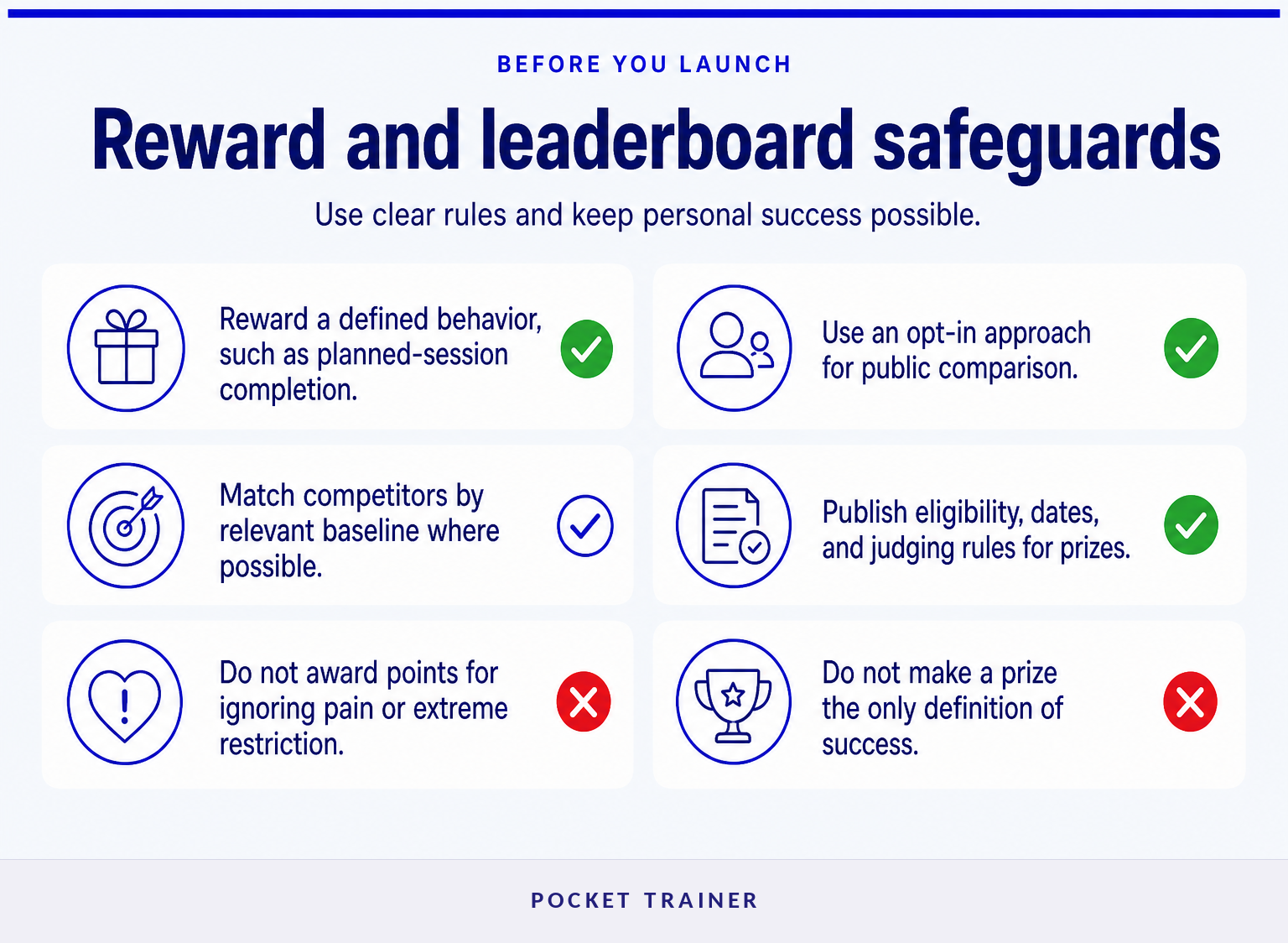
Rewards, prizes, and leaderboards can add energy, but they can also pull attention toward the wrong outcome. Use them when the rules are transparent, the action is safe, and every client still has a realistic path to personal success.
Recognition does not need to be expensive. A private message acknowledging consistency, a completed milestone, access to the next phase of a program, or a client-selected reward can be enough to make progress feel visible. The value comes from the connection between the behavior and the feedback.
Prizes require more guardrails. Explain the eligibility rules, dates, judging criteria, and what data or images participants need to provide. Avoid language that implies that a prize is available to every participant, or that a body transformation is the only valid sign of progress.
Leaderboards need an opt-in approach. A group can compare attendance, check-ins, or a percentage of planned workouts completed, but only if the metric is comparable. Do not rank clients by metrics that are not equally available or appropriate for them.
If a client has pain, disordered-eating concerns, a health condition, or a history that makes comparison unhelpful, remove the competitive layer and follow the client’s qualified healthcare guidance where applicable.
A reward system is useful only when it reinforces the behavior the program is meant to build.
How do you measure whether gamified workouts are helping?
Measure the behavior the game was designed to support, then compare it with the client’s own baseline. Look for completion, check-ins, and whether the mechanic reduces common friction such as forgetting sessions, losing track of progress, or waiting too long to reconnect after a missed workout.
Use a small scorecard at the end of each cycle:
- Completion: What percentage of planned sessions did the client finish?
- Engagement: Did the client log progress, send check-ins, or respond to feedback more consistently?
- Experience: Did the client say the challenge made the next action clearer or more enjoyable?
- Appropriateness: Did the score encourage the intended behavior without creating pressure to overtrain or compare?
Keep expectations proportionate. The 2024 systematic review of 36 trials and 10,079 participants found a modest average increase of 489 steps per day for digital health apps with gamification compared with non-gamified versions, alongside slight average improvements in some body-composition outcomes. The authors did not find meaningful differences for every outcome, so trainers should treat gamification as a supportive design choice rather than a promise of retention or transformation. Read the 2024 review
A game mechanic is working when it helps the right client repeat the right behavior, not when it produces the flashiest score.
What else do trainers ask about gamifying exercise?
What are some examples of gamification exercises?
Examples of gamification exercises include a three-workout completion streak, a movement-practice quest, a weekly check-in badge, a group attendance target, and a personal progress bar. Each example should be attached to a programmed behavior, such as completing planned strength sessions, rather than rewarding random exercise volume or unsafe intensity.
How can I gamify exercises?
To gamify exercises, choose one client behavior to reinforce, set a personal baseline, show visible progress, define a small milestone, and review the result after a fixed period. Trainers can use points, streaks, challenges, or rewards, but the system should remain simple enough for clients to understand without extra explanation.
Which app is the best for gamifying exercise?
The best app for gamifying exercise is the one that supports the trainer’s chosen client behavior without adding unnecessary complexity. Look for clear goal setting, progress monitoring, client communication, and an easy way to adapt workouts. A trainer should test the workflow with a small client group before making it part of every program.
What are the four types of gamification?
Four practical types of gamification for exercise are progress gamification, challenge gamification, social gamification, and reward gamification. Progress makes improvement visible, challenges break a goal into missions, social mechanics add accountability or comparison, and rewards recognize defined actions. Trainers can use one type or combine them carefully.
What should a trainer do next?
Choose one client segment, one behavior, and one four-week challenge. Build the rules around progress the client can control, then review the result before adding points, prizes, or competition.
For trainers who want a client app with workout content, customizable workout and nutrition guidance, in-app communication, goal setting, progress monitoring, and an optional Transformation Challenge, book a Pocket Trainer setup call and build the first challenge around a real coaching goal.