
In short
A personal trainer website that sells online training does not need dozens of pages. It needs one clear offer, proof that the trainer is qualified to deliver it, a simple explanation of what clients receive, and one low-friction way to join or make contact. A focused sales page can be the right starting point when speed matters.
Key takeaways
- ✅ A personal trainer website should lead with one specific online offer, not a vague promise to help people get fit.
- ✅ Prospective clients need to see who the program is for, what they receive, how support works, and what to do next.
- ✅ A focused sales page can be a better first move than building a large website when a trainer is launching one defined online service.
- ✅ Social posts, referrals, and an Instagram bio work harder when they lead to a page built to answer buying questions.
- ✅ Set prices based on the service scope, support level, audience, costs, and local market rather than copying a generic online rate.
Contents
- Does your personal trainer website need a full website?
- What must a personal trainer sales page say?
- How should a website turn interest into online clients?
- Which launch route fits your training business?
- Frequently asked questions
A striking design can earn a second look. It cannot do the selling by itself. A visitor who arrives from a referral, a social post, or a search result should understand the offer in seconds: who it is for, what changes, what they get, and how they can start.
For a trainer selling online or hybrid coaching, the site is not just a digital business card. It is the bridge between interest and an ongoing client relationship.
Does your personal trainer website need a full website?
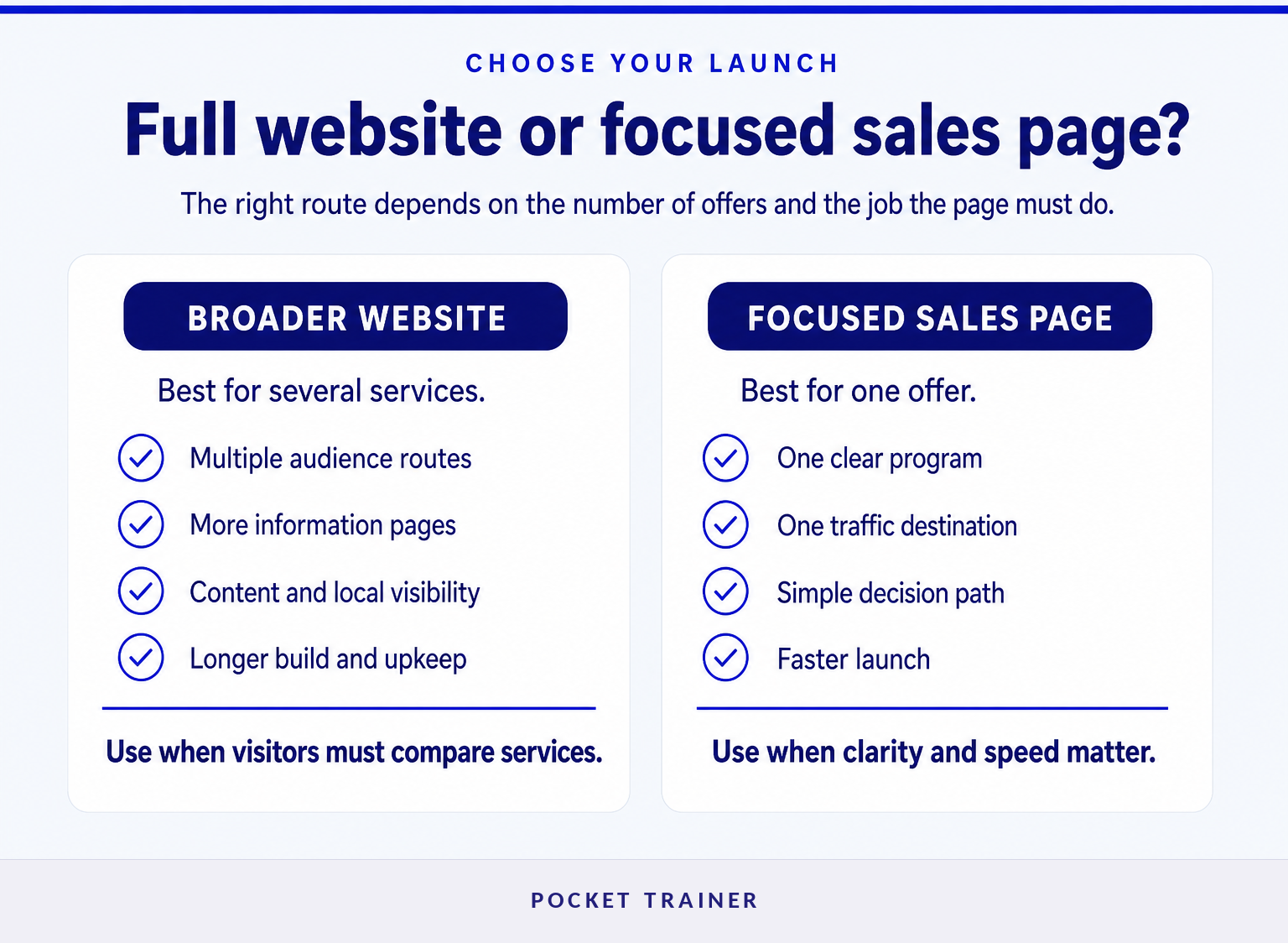
No. A trainer who has one defined online service can often start with a focused sales page, then add a broader website as the business, content, and service range grow. The better option is the one that removes uncertainty for the prospective client without creating a long build project for the trainer.
A full website makes sense when the business has several audiences or services to explain. For example, a trainer may need separate pages for in-person sessions, online coaching, corporate work, group classes, a team, educational content, and local search visibility. In that case, navigation helps people find the relevant route.
A sales page is narrower by design. It gives one visitor one job: decide whether a particular offer is right for them and take the next step. That can be especially useful for a trainer whose audience mostly arrives from a single Instagram link, a referral, a challenge campaign, or an email.
| Choose a broader website when… | Choose a focused sales page when… |
|---|---|
| You offer several services with different buyers. | You are launching one online program or membership. |
| You need location pages, articles, or detailed brand information. | Most traffic comes from social media, referrals, or one campaign. |
| Visitors need to compare multiple routes before deciding. | Visitors need a direct explanation and one clear action. |
| You have the time and budget to maintain more pages. | You need to launch, learn, and improve quickly. |
A sales page is not a shortcut for an unclear offer. It is a compact format that forces the offer to become clear.
What must a personal trainer sales page say?

A personal trainer sales page must answer the practical questions a cautious buyer has before joining: who the program is for, what they receive, how much support is included, and what happens after they sign up. It should earn trust with specifics, not hype.
Start with a headline that identifies the intended client and the result the program is designed to support. “Online fitness coaching” is a category, not an offer. “A four-day strength plan for busy professionals who want structured gym sessions and weekly accountability” gives a visitor something they can assess.
Then explain the delivery. State whether clients receive workouts, exercise demonstrations, nutrition guidance, messaging support, progress tracking, check-ins, or a combination of these. Do not imply live calls, custom app ownership, wearable integrations, or other capabilities unless the service genuinely provides them.
Use a real trainer photo and a short credential or experience summary. Add client stories only with permission, and describe results carefully. Before-and-after images can show context, but they do not guarantee the same outcome for every person. A credible page makes the individual nature of results clear.
The page should also make the commitment visible. If the offer has a one-time payment, recurring subscription, consultation step, or application process, say so before the final call to action. Hidden details create avoidable hesitation.
Pocket Trainer's current product page describes a customizable sales page that can include a trainer headline, headshot, custom URL, welcome video, and client transformation images. It also describes client access to workout content, workout and nutrition customization, messaging, goal setting, and progress monitoring. (pocket-trainer.co)
A visitor should be able to describe your offer accurately after reading the page once.
How should a website turn interest into online clients?
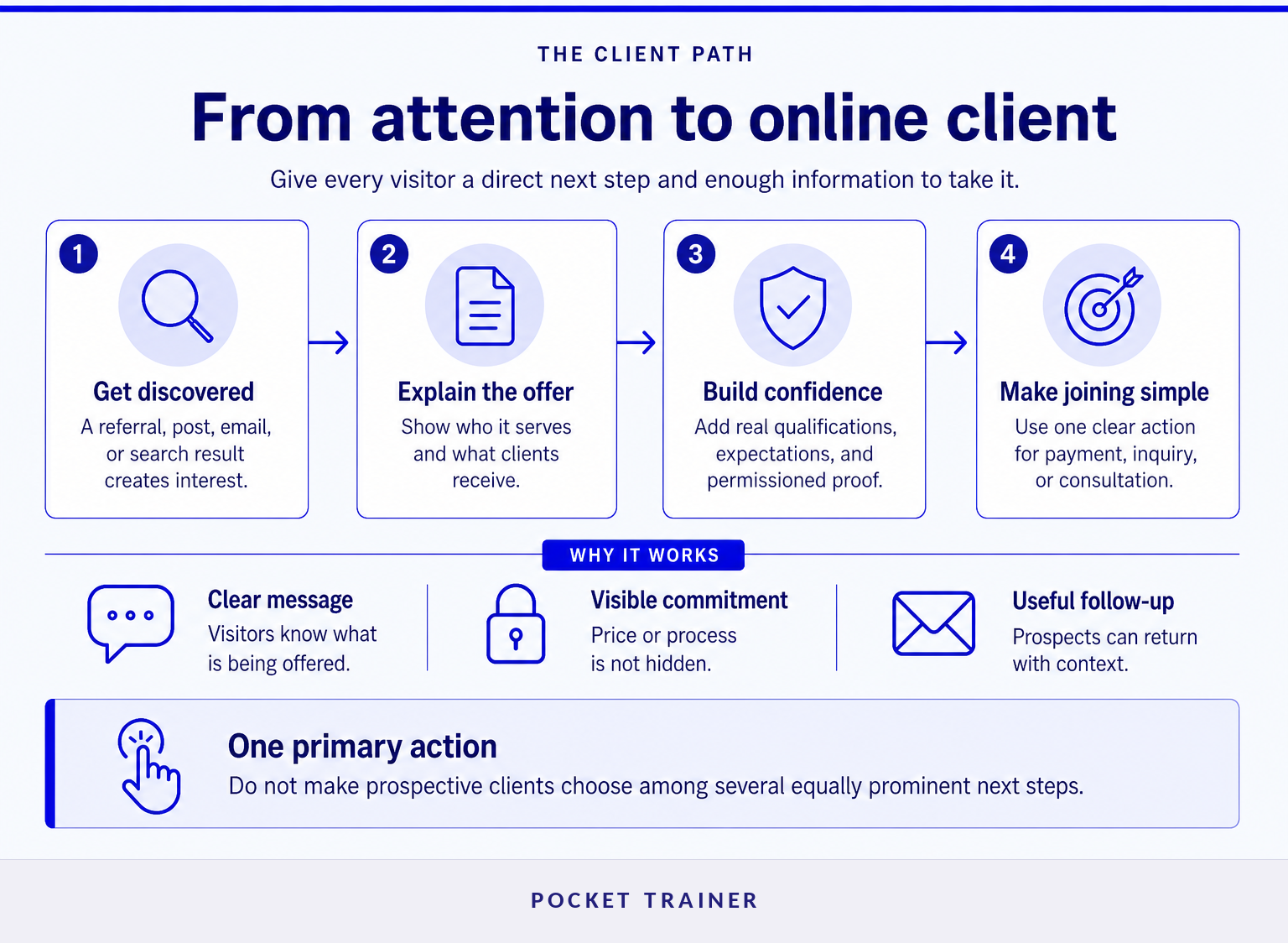
A personal trainer website converts interest when every section reduces one buying question and the next action remains obvious. The page should move from recognition, to trust, to delivery details, to a single action without sending visitors into a maze of menus.
Use one primary call to action. It might be “Join the program,” “Start online training,” or “Request a consultation,” depending on the offer. The exact wording matters less than the clarity of the commitment. A page with three competing actions often leaves people choosing none of them.
Build the page around the source of the visitor. A referral may need a fast overview and proof. A social-media visitor may need more explanation because they know your content but not your service. A search visitor may need clearer comparison details because they are actively evaluating options.
Follow-up matters after the click, too. Pocket Trainer states that it provides an automated prospect email sequence for people who visit a trainer's sales page but do not join immediately. That kind of follow-up is useful only when the original page has earned permission to continue the conversation and the messages give the prospect a genuine reason to return. (pocket-trainer.co)
The service experience must match the promise on the page. If clients will access programming and communicate through an app, explain that early and link it to the outcome: convenient access, a plan they can follow, and a way to stay connected. For a closer look at the delivery side, see this guide to personal trainer client apps.
A visitor is more likely to act when the page makes the next step feel specific, expected, and proportionate to the decision.
Which launch route fits your training business?
The best website for personal trainers is not automatically the one with the most templates or features. It is the route that lets a trainer present a credible offer, take payment or inquiries appropriately, and deliver the service promised without building systems they do not need.
A do-it-yourself website can be appropriate when a trainer wants complete control over layout, copy, content, and integrations, and has the budget or skills to maintain them. It can also suit trainers whose brand depends on a large library of original content or a highly customized service structure.
A managed sales-page route suits a different situation: a trainer wants to begin selling a standardized online offer without first producing a video library, building an app, creating a payment flow, and writing every follow-up sequence. That route trades some flexibility for speed and less operational work.
As of October 2026, Pocket Trainer says trainers can use its customizable sales page, supplied workout and nutrition content, client app, and optional recurring-payment checkout. Its site states that trainers keep 90% when using its checkout, while trainers who collect payment themselves keep the full amount they collect. (pocket-trainer.co)
The decision is not “website versus no website.” It is whether the sales presence supports the business model you can realistically launch and operate now.
If a ready-made client app and customizable sales page fit the offer you want to sell, see how Pocket Trainer works. Start with one clear program, send real traffic to one clear page, and improve the message from the questions prospects actually ask.
Frequently asked questions
Where do personal trainers find clients?
Personal trainers find clients through referrals, existing gym relationships, local partnerships, social media, search visibility, and former clients who return when their needs change. A website helps only when it gives each source a clear destination: an offer page that explains the program, establishes trust, and states the next step without confusion.
What is a reasonable price for an online personal trainer?
A reasonable online personal-training price depends on the trainer's niche, program length, level of personalization, check-in frequency, included nutrition support, and market. Set the price after defining the service scope and delivery cost. Compare it with alternatives your target clients genuinely consider, rather than copying a broad online average that may not match your offer.
What is the best website builder for personal trainers?
The best website builder for personal trainers is the one that supports the way the trainer sells and delivers services. Choose a full website builder when multiple services, pages, and content need to be maintained. Choose a focused sales-page solution when the immediate goal is to explain and sell one online program with minimal setup.
How much is a 1 hour PT session?
The price of a one-hour personal-training session varies by country, city, trainer experience, training location, specialization, and whether the client buys a package. Online coaching should not simply copy an hourly in-person rate, because its value may come from programming, support, accountability, and ongoing access rather than one scheduled hour.
A personal fitness trainer website earns its place when it makes the offer easier to buy and easier to deliver. Build the smallest page that can answer a serious prospect's questions, then let real client conversations show you what to improve next.